Kickstarter Weekly - Jan. 9, 2013—errr...14

TinyEpicHey everyone! We're getting things back up and running in the new year, and we certainly hope that you and yours had a magnificent time during the holidays. We're back this week with this year's first Kickstarter Weekly! Should all acquaintance be forgot? NOPE! There are a lot of exciting things happening on Kickstarter with some perennial favorites launching campaigns this very day! So sweep up that confetti, put the lampshade back on the lamp, and stop writing 2013 on your checks... Seriously... Who uses checks anymore!? It's time for Kickstarter Weekly!

Featured Campaign

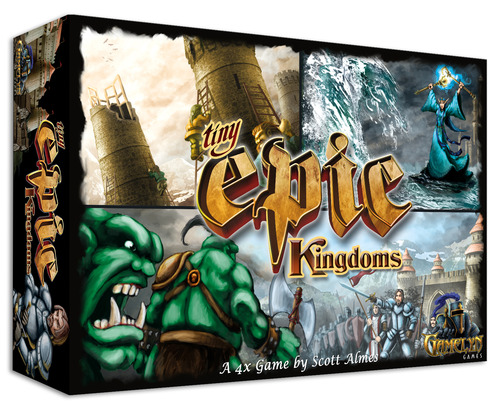
Tiny Epic Kingdoms - Gamelyn Games

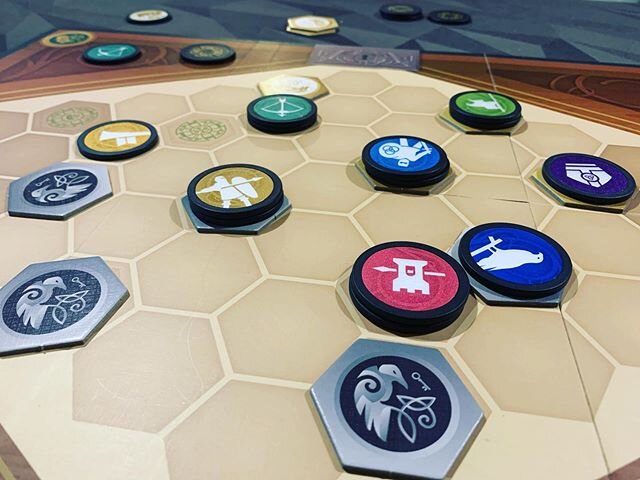
This campaign comes from our good friends over at Gamelyn Games. This is the first title from Gamelyn that hasn't been designed by founder Michael Coe. Gamelyn has a successful history on Kickstarter with their charter campaign of Dungeon Heroes delivering what backers wanted and more! TEK is a mini 4x game that has been all the rage over social media as of late.

The Campaign ends on Feb. 8 and a pledge of $16 get's you the base game and $24 will score you a deluxe copy. Find all the info on the campaign, right here!

burgooBurgoo - A Pay-What-You-Want Game of Community Stew - Tasty Minstrel Games

Hot on the heels of  their ridiculously successful Pay-What-You-Want campaign for Coin Age, which is quite possibly the microest of micro games, Tasty Minstrel Games is at it again with Burgoo. A game about building stew. The rules seem simple enough: Manage to get all of your ingredients into the stew and win.

The recommended pledge is $5, but a $3 pledge will get you a copy of Burgoo, sent to anywhere in the world!! The campaign ends Jan. 25 and you can find out all the details: Right here!

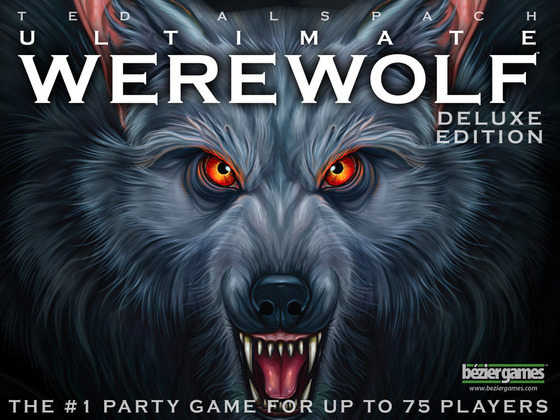
Bezier WerewolfUltimate Werewolf - Bezier Games

Another take on the classic game. Ultimate Werewolf supports up to 75 players... Yes, seven-five. This campaign adds a ton of new features, updated art, lots of new variants, character roles and so on. If you're into Mafia and Werewolf and the like you should check this one out!

The campaign ends Feb. 3, and a pledge of $25 will get you a copy of the game. Click here, for all the details!

SpearpointSpearpoint 1943 Eastern Front - Collins Epic Wargames

The third in the Spearpoint series, Eastern Front brings unit cards for the Russian forces and more German forces units as well. I (Jeremiah) got to play the original Spearpoint 1943 back when it released at Origins a few years ago. It's a fun lightweight card combat game for two players. It allows for customization of decks, but only within the constraints of what you get in the box—much like  an LCG, there's no card-chasing here!

The campaign for Eastern Front ends on Jan. 20, and a pledge of $29 will score you a copy of the game. You can find out all the details, right here!

An Interview With Ninja Dice Designer Rocco Privetera, and Jeff Gracia of Greenbrier Games

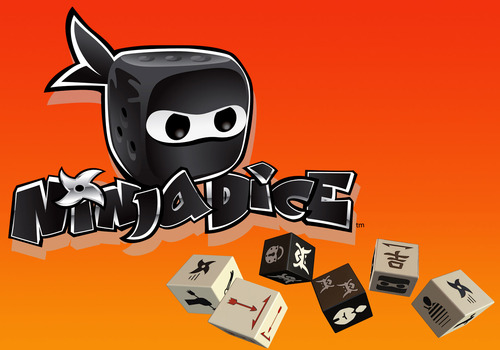
NinjaDiceHey, thanks for joining us today, as we talk with Rocco Privetera, designer of Ninja Dice, and Jeff Gracia, of Ninja Dice publisher Greenbrier Games.

Guys, thanks for joining us today!

Rocco: You are most welcome! Gonna have to squeeze this in between various day jobs, the Kickstarter, and my nightly nervous-Kickstarter-fretting schedules!

Jeff, Rocco, tell us a little bit about yourselves—is there any random thing our readers should know about you?

Rocco: I’m an ex-professional Jazz pianist, comedy improviser, and a kitten just crawled through my window a few weeks ago. I named him “Ninja”. Now that we’re funded I guess I get to keep him?

Jeff: I’m a software engineer by day and game designer and publisher by night.  Zpocalypse was my first creation, self-publishing the game paved the way to design and publish more games.  Such as working with Rocco on the design and publishing of Ninja Dice under the Greenbrier Games banner.

Jeff, can you tell us about Greenbrier Games—what you've been able to accomplish, and what your goals are?

Greenbrier Games is a board game company created by a group friends. Due to the success and support of Kickstarter our dreams became a reality, and thus Greenbrier Games was born.  The long and short of it is we are a bunch of people working day jobs to support our addictive habit of creating board games!  For those interested in the in-depth story of how I convinced my friends to following me down the rabbit hole, check out our About Us on our Web site:  http://www.greenbriergames.com/gbg/index.php/home/aboutus/

NinjaDiceDiceRocco, Ninja Dice sounds really fun. Can you fill us in a little on the genesis of the game, and how it plays?

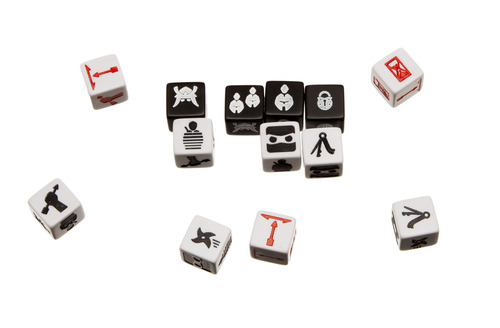
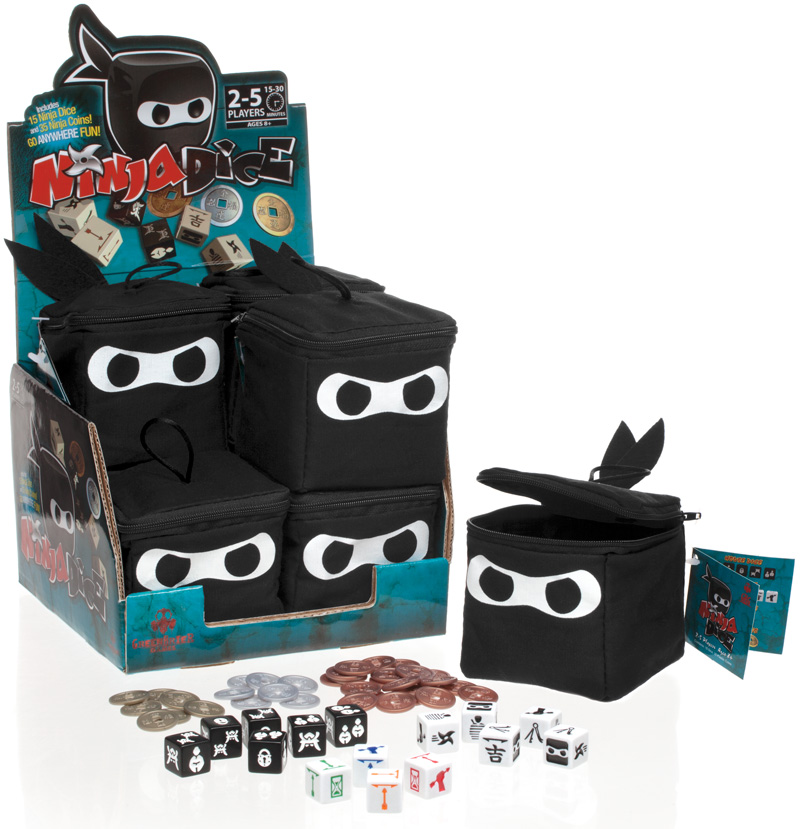
Rocco: Ninja Dice was created because a different publisher put out a call for submissions for a push-your-luck dice clone. I was trying to learn game design from a “how do you actually finish something” perspective, and thought it would be a good choice. Ninja Dice is a tight game with 15 dice and some money in its basic version. Every turn the active player is trying to beat a House formed out of House dice that show challenges in the House: Guards, the Residents, and Locked areas. The active player rolls and re-rolls Skill dice to get the Skills necessary to beat the House: Fighting, Sneaking, and Lockpicking skills (as well as Wilds and die-boosting-Fortunes). Meanwhile, while this is happening the other players are rolling dice to slow him down, which may stop him, while they are also stealing money from the active player—and each other!

So what sets Ninja Dice apart from other push-your-luck dice-rollers?

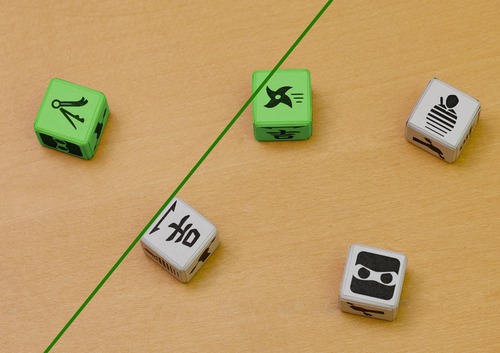
Rocco: Unlike a lot of “multiplayer solitaire” games, everybody is involved and interacting all the time. The inactive players are rolling Threat dice to use up the active player’s time and to steal money from the active player and each other, so you are never sitting around waiting for your turn. Also while it’s definitely a casual game, it has a surprising amount of strategy—you never just roll the dice and “do the one obvious thing” like a lot of other PYL games. It also plays in three rounds instead of to a point limit—thanks to the interaction, there isn’t a clear winner sometimes until after the last arrow is fired and the last coin stolen, which leads to a lot of dramatic close finishes.  And, of course, it has my fun “arc of fire” mechanic, which leads to a lot of dramatic and interesting gameplay.

NinjaDiceArcHow did you come up with the awesome idea of an arc of fire depending on how the dice land?

Rocco: I was doing some odds calculations and was trying to find a way to make a specific die face come up less often than 1 in 6 and thought “well, what if it only works when something is on side of the die? That’s about 50% of 1 in 6,” and went from there. Now that we’ve used it, of course, I can imagine a lot of other similar mechanics that can be derived from the idea.

You've pushed past the funding goal, so Ninja Dice will be brought to market (congrats!), tell us a little about the stretch goals you've got planned?

Rocco: There’s a bunch of them! We’ve got some that enhance the base game, like plastic money coins instead of cardboard tokens to keep score, and colored Threat dice so everyone using them has a unique color. Then exclusive promo cards for other games Greenbrier works with, like Zpocalypse. And a bunch of new gameplay add-ons called “Location Cards” that add some advanced gameplay options to the game.

Jeff: Little do people know our location cards have turned into a full-fledged expansion. Being a game addict, I wasn't satisfied with just giving the Kickstarters a few cards to tease them.  After some math-crunching, and some easy convincing of Rocco, we turned the few promo cards into a full-blown expansion, more than tripling the card count.  I can’t wait till Kickstarters realize the extra bonus they are getting!

What are some of your favorite games? (Besides Ninja Dice, of course…)

Rocco: Well Zpocalypse is my current Zombie fave, of course. :) Other than that, my group tends to vacillate based on who shows up. We’ve been enjoying Deadwood Studios, Shadows over Camelot, Pandemic, and, of course, a few of the next designs of mine I force… I mean... encourage my group to playtest.

Jeff:  Some of my top games are BattleStar Galactica, recently Rampage, Race to the Galaxy, Mage Knight, and many more!

NinjaDiceProductionSamples13546-800x829Are there any other projects (from either of you) that you can share with our readers?

Rocco: My life consists of my stumbling from one creative project to the next (all on hold while the Kickstarter finishes). You can go to http://www.privetera.com for an overview of everything. It’s a lot.

Jeff:  Early February we'll be announcing our next project; please stay tuned for another announcement :P

It’s time for the Versus Version of 1-Word Answers! Who would win?!

Bruce Lee vs. Chuck Norris?

Rocco: I want to say Bruce Lee but Chuck might be listening. Chuck Norris.

Jeff:  Chuck Norris—after all, that’s not a chin under his beard—its another Fist!

American Ninja vs. Karate Kid?

Rocco: Jaden Smith Karate Kid < American Ninja < Macchio Karate Kid

Jeff: Karate Kid!

JCVD-splits-1Jackie Chan vs. Jean-Claude Van Damme?

Rocco: Mostly Jackie Chan, but Van Damme is aging much better, so a few years from now…

Jeff: Jackie Chan!

Jet Li from the Matrix vs. Jet Li from Lethal Weapon 4?

Rocco: Software Jet Li!

Jeff: Jet Li from Lethal Weapon 4

Crouching Tiger vs. Hidden Dragon?

Rocco: I’m a Shaolin Long-fist practicioner. I’d be be way more scared of Tiger guys!

Thanks for taking the time to talk to us!

Rocco: Thanks for the opportunity! And thanks to Jeff at Greenbrier Games for giving me the opportunity to make the game with them!

Jeff: Thank you all for taking the time to check out our latest project!

Ninja Dice already funded on Kickstarter, but you can check out the game on Greenbrier's Web site, or on the Geek. Thanks so much for reading!

Bottom Banner

Boss Monster—A Double-Take Review

bossmonstercoverYes, no, maybe... I don't know. Can you repeat the question?You're not the boss of me now, and you're not so big!

- They Might Be Giants

Last year saw the onset of one of the biggest crazes to hit board games: card games that look like video games from 25 years ago.

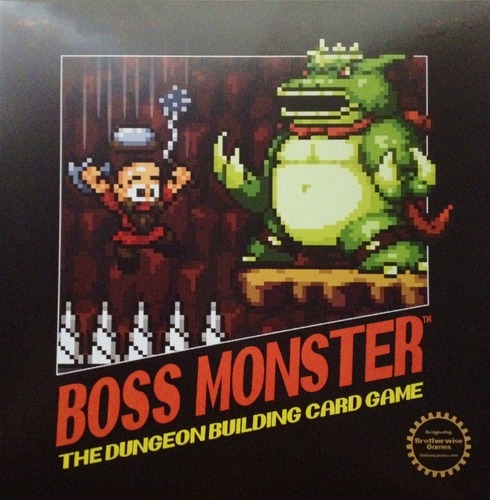
Today we're taking a look at one of the most successfully crowd-funded games in this genre—Boss Monster: The Dungeon-Building Game.

Do you have what it takes to build the best, baddest, and most enticing dungeon, in order to destroy the hapless heroes that may wander in looking to loot your treasure? Let's take a look!

The Overview

You are a Boss Monster, and you're building your dungeon room by room. You know those jerky heroes from the town will come for the loot, so you have to build a dungeon that can take them down—or they'll take you down.

The Components

Cards...lots and lots of cards. There are several different types:

  • Boss Cards—These indicate which character you will be for the game.
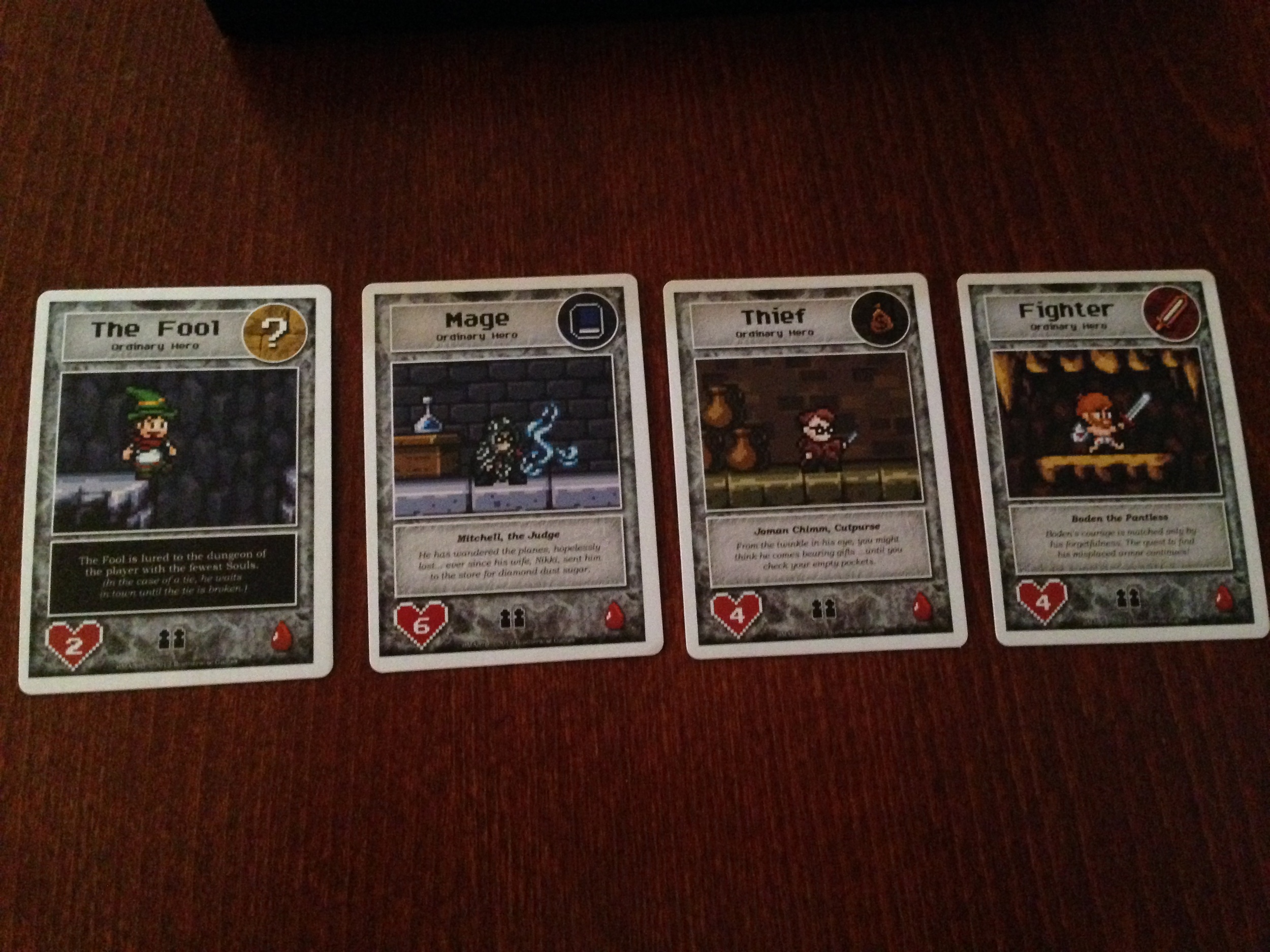
  • Hero Cards—There are two types of Hero Cards, the regular type and the epic type (which sport a gold back). These are your enemies, and killing them off is ultimately how you score points to win the game.
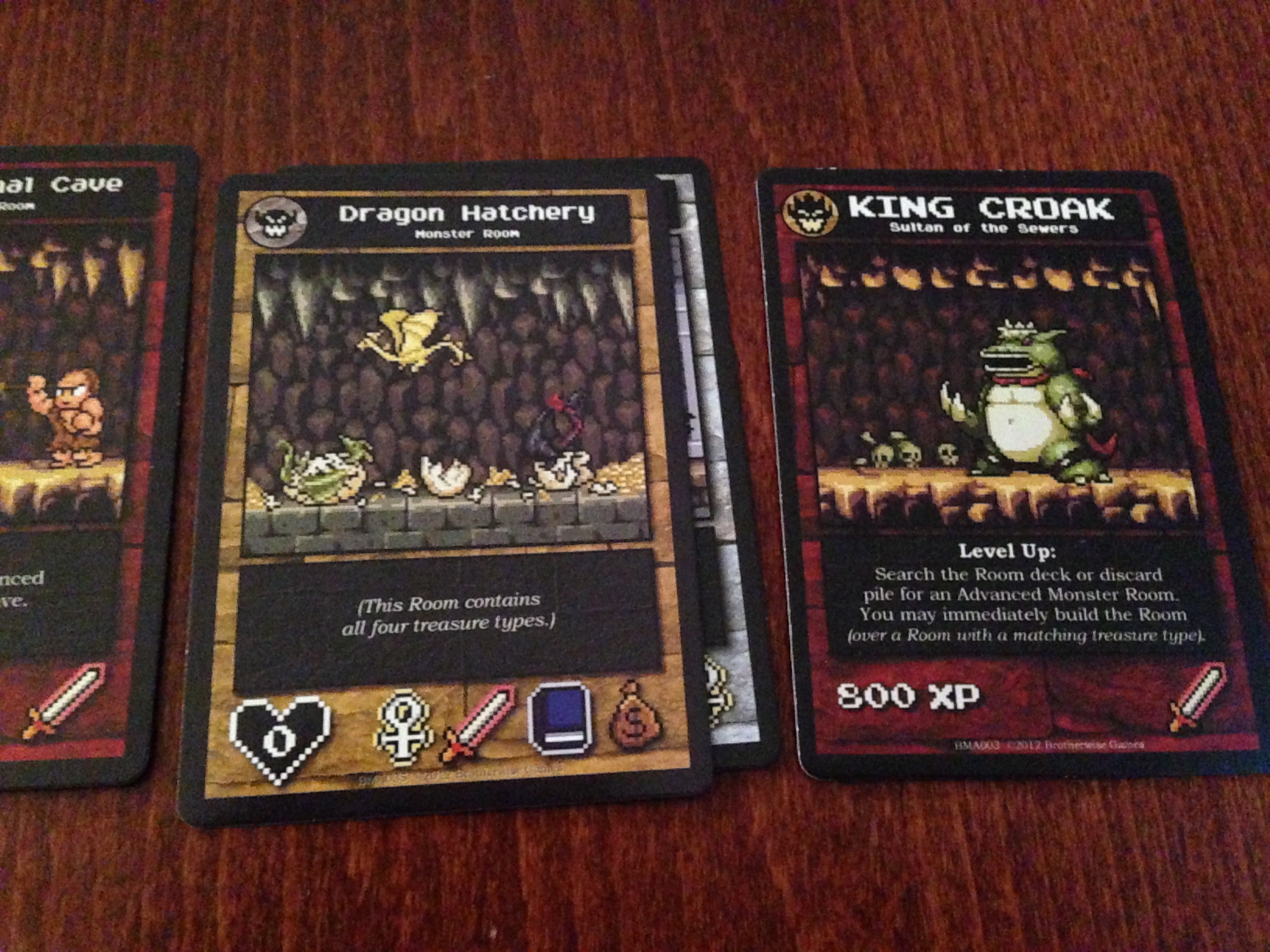
  • Room Cards—This is the most plentiful type of card, and there are a few different types of Rooms, including trap Rooms, and monster Rooms. And there are basic and advanced Rooms in each type.
  • Spell Cards—Spells are a little hard to get into your hand, but they act as a one-time event or interrupt card that can be played during either the Build Phase, or the Adventure Phase, but now we're getting ahead of ourselves.

photo 2The Setup

Setup the Hero Deck by including the proper heroes depending on the number of players (each hero has a number of icons denoting the minimum amount of players in the game for that card to be used in). Each player is then randomly dealt a Boss Card, which will give them an identity, as well as an XP value that will help when determining who goes first. It will also give them a one-time level-up ability. Each player then draws five Room Cards and two Spell Cards, and chooses two among all of those to discard. They then build their first Room by placing a Room of their choice to the left of their Boss Card. Then you're ready to go!

The Gameplay

The game plays in a series of rounds rather than player turns. Here is a brief summary of how this looks:

Beginning Phase—Heroes are revealed from the Hero Deck (one for each player in the game). These Heroes will have a heart symbol with a number in it, indicating how many hit points they can withstand, and a treasure icon, which is the type of treasure they've come looking for.

Build Phase—Each player can build one Room in his or her dungeon (building right to left from their Boss Card). Advanced Rooms can only be built onto an existing standard Room with the same treasure icon.

Bait Phase—Each dungeon will be inspected for the number and type of treasure types and compared with the Heroes in town, and whoever has the most of one type will lure each Hero of the matching type to the entrance of their dungeon. If there is a tie, then no one will lure the Hero, and likewise, if there is no treasure in any of the dungeons, then the Hero stays in town.

Adventure Phase—The Heroes who are brave enough to venture into the dungeon seeking plunder go through each Room from left to right until they are either killed or reach the Boss. Room cards have a black heart icon with a number that indicates the amount of damage it inflicts on the hero. If the hero is killed, it's turned over revealing either one or two gold coins, depending on the level of the Hero (these are the VP's, referred to as souls; Epic Heroes apparently have two souls). If the Hero makes it through without dying, it's placed under the Boss Card leaving the one or two blood spots exposed, which represent a wound to your Boss.

End of Turn—Check to see if someone won. If a player receives 5 wounds, that player is out of the game; if a player at any time gains 10 souls/points, he or she is declared the winner. If not, go to Beginning Phase.

photo 3The Verdict

Jeremiah—The thing I keep coming back to on this game is that it's very unique. And I mean that as a compliment. Boss Monster is exactly what it says it is: it's a game about building a dungeon, and being the best bad guy at the table. The components are simple: It's cards. But the graphic design is genius; it strikes that sentimental/nostalgic/novelty button just right.

Firestone—I agree. The theme is unique and fun and completely integrated. There are a couple of other games that are similar (Dungeon Lords, for instance), but this is of filler weight and length, so doesn't feel at all like it's ripping off. I really do like the pixelly, retro art. It's nostalgic, but man, there are a LOT of games out now that are putting all of their gameplay eggs into the nostalgic, 8-bit basket.

Jeremiah—Yeah, it's a "thing" right now. Just like after Dominion was a huge success we saw a ton of deck-builders, now that a few Kickstarters have gone bonkers with the retro look, many others are following suit.

Back to my statement about this game being unique: Unlike so many games that are hitting the market, it's really hard to slot this into any genre, in terms of gameplay mechanics. It's not deck-building, or set-collection, or resource-management. It's dungeon-building and killing heroes with some hand management; it's also fun.

Firestone—I completely disagree on the fun. But then...I hate fun, right? ;) This is the sort of game that's truly "dripping with theme," but unfortunately they spent all of their effort on theme, and little on the gameplay. I found it boring and repetitive, and I never felt that I had much control or meaningful decisions to make.

I built my dungeon, but whether it was enticing to a Hero was entirely dependent on which Heroes came out from that random deck of cards. If you built a Magic-heavy dungeon and a Magic Hero came out, good for you! If a Thief came out...tough noogies. Sure you could spread out the type of treasure, but that just meant that anyone who specialized even a little would beat you. And since you can only have five rooms in your dungeon, you have to commit and then hope for the best. Blech.

photo 4Jeremiah—Well if I'm recalling properly, I'm pretty sure there is an even number of the different types of Heroes in the deck—with the exception of the fool and a couple other specials—which means as you go through the deck if you are specializing, each dungeon is going to have a shot at enticing the same amount if Heroes into it. Sure you're going to have to decide whether to compete with your opponents or try to diversify and snag one or two of each type. And sometimes you just have to play the cards you're dealt... That's why it's a card game. ;)

Firestone—Look, I know 8-bit games, and practically every boss monster I ever fought...FOUGHT BACK! But if a Hero gets to my Boss Monster he just rolls over and takes a hit? Wha?! Most of this game is thematically rich, but that just detracts from the theme. Why even have different Boss Monsters if all they really are is a card to track hits? Oh, right...one-time-use level-up powers. Zzzz... And don't get me started on the different XP for the Bosses. "Wait...XP breaks ties, and we're randomly dealt these Boss Cards?"

Jeremiah—Well, yeah, the Boss takes ONE hit, and then devours or beats to a bloody pulp or whatevers the Hero; it takes 5 heroes to take down the boss; I'm totally okay with that.

It's a short game and the level-ups being a once-a-game bonus is sometimes just enough to get you back in the thick of it! XP breaks ties, and higher XP means a little weaker power for your level-up ability; it seems to balance out pretty well to me. If you get a higher XP Boss then you get an initial advantage, but it evens out when you level up. I was totally fine with that.

Firestone—I understand that the enjoyment of these sort of games is highly dependent on the group. But most of the people I game with don't like "experience" games, or theme-only games (which is why I LIKE gaming with them), and this game went over like a lead balloon.

My oldest liked the theme, and thought the gameplay was kinda fun. But after the second game even he was acting visibly bored.

I know the guys at Brotherwise made a TON of money on this Kickstarter campaign, so good for them. Honestly. But for me, this is just thematically rich, and gameplay poor.

Jeremiah—The only reason I would hesitate to play this with anyone and everyone is that there are a few cards that are just a shade past family friendly because of their title/concept, such as the Succubus Spa, and the Vampire Bordello. There's nothing gratuitous on them, unless extremely pixelated babes are your thing... Thematically they make sense, but I would suggest pulling those cards out before playing with the kiddos.

Firestone—I don't begrudge them adding these cards, since they fit thematically. But yeah...I certainly pulled them out when I was playing with my 9-year-old...

Jeremiah Final Thoughts—I have yet to play this game just once—it plays fast, and it leaves you wanting another go 'round. Boss Monster is fun, thematic, and unique; I recommend you put this one on the table!

Firestone Final Thoughts—It works for kids. It might work as an occasional filler. And there are certain gaming groups that will eat this up. But as for me and my game group, we'll be keeping this one off the table.

Theology Of Games would like to thank Brotherwise Games for providing review copies of Boss Monster. This in no way affected our opinion of the game.

Thanks for reading! Have you played Boss Monster? Which one of us do you agree with? Let us know in the comments!

Ringing In 2014

fireworksThank you so much. 2013 has been a great year here at Theology Of Games, and it wouldn't be anything without you. So thank you. But as we look ahead to 2014, we want to resolve to bring you more.

More reviews. More interviews. More news. More podcasts. More YouTube videos.

But what else can we do? What do you want to see more of? What can we do better? We TRULY want to know, so let us know in the comments or click a few boxes in the poll below, how we can better serve you.

We hope you're getting together with some loved ones tonight. Stay safe. And we'll see you in the new year. Look for our Top Games of 2013 post next week.

While we've got you, would you be willing to swing by this site and vote up Theology Of Games? Right now we're at 29; would you help us go higher? And while you're there, vote for some other sites, too. We're particularly fond of islaythedragon. Thanks!

[polldaddy poll=7686260]

Bottom Banner

For Unto Us a Child is Born...

This year we've both experienced the stresses of life; the hustle & bustle; and the joy, wonderment, and hope that comes with the holiday season. But we wanted to take a minute, and a deep breath ,and say thank you to all of our readers, subscribers, followers, and.... likers???And to wish you a very Merry Christmas and holiday season. May the true meaning of Christmas be enough for us all.

Manger-Gustave-Dore And in the same region there were shepherds out in the field, keeping watch over their flock by night. And an angel of the Lord appeared to them, and the glory of the Lord shone around them, and they were filled with great fear. And the angel said to them, “Fear not, for behold, I bring you good news of great joy that will be for all the people. For unto you is born this day in the city of David a Savior, who is Christ the Lord. (Luke 2:8-11)

We will be back a little later in the month with our regular flow and schedule of content. Until then you officially have our permission to take a break, be with the ones you love, and, of course, get a game in the table!

Merry Christmas to all!

Jeremiah & Firestone

Fantasy Flight Announces a New Deluxe Expansion for Netrunner

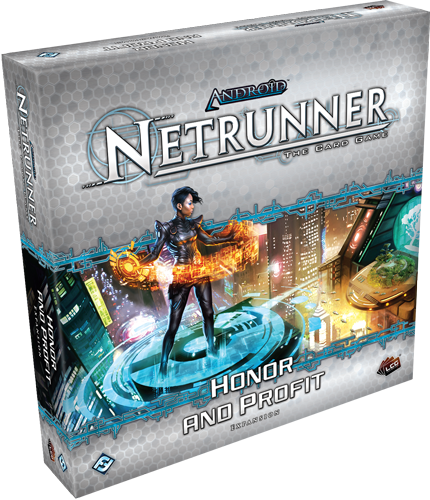
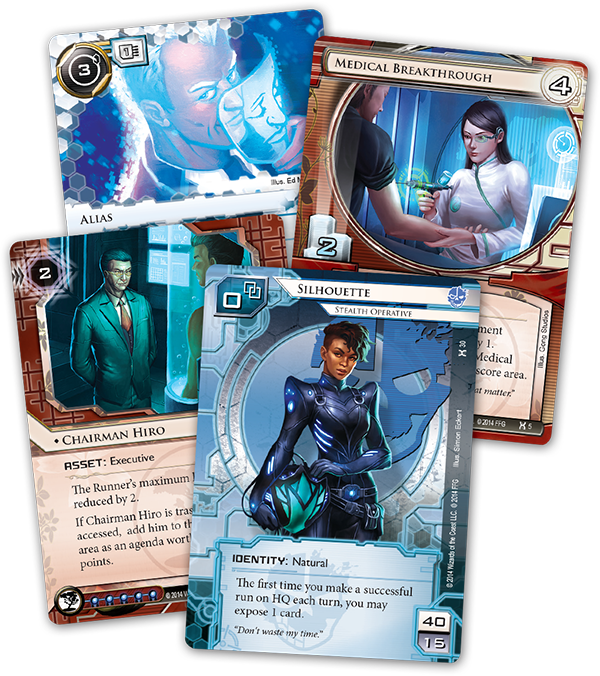
honorcoverIn their never-ending quest to separate me from my money, Fantasy Flight has announced Honor & Profit, a new expansion for Android: Netrunner—this time a deluxe expansion.

This one focuses on the Jinteki Corp, and the Criminal Runners—though you're free, of course, to use these cards in any deck you'd like. Though it'll cost you...

There are also some new neutral cards. The 165-card expansion is scheduled for release in the first quarter of next year. honorcards

IOS Sale—Small World 2: 50% Off

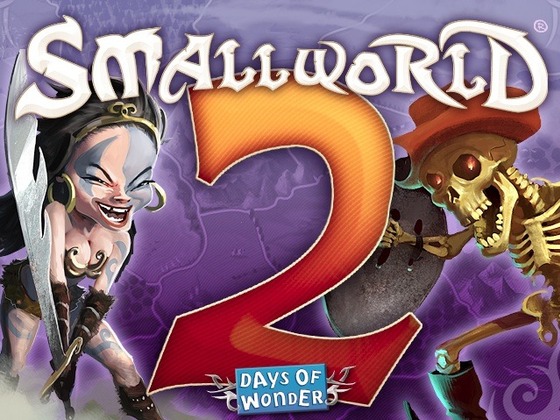
SmallWorld2Here at Theology Of Games, we're big fans of the game Small World. And you can now get the iOS version of Small World 2 for a small-er price!

It's only $4.99, down from $9.99.We have no idea how long this will last, so go, go, go!

Just think: For the holidays maybe you travel west, to stay with your in-laws on their uncomfortable "antique"bed (which is code for uncomfortable), and you wake up ridiculously early because of the time change and the uncomfortable bed and because you drank three glasses of egg nog and you REALLY have to pee. Now you'll have something to do while you wait for other people to wake up! You're welcome.

An Interview with Yehuda Berlinger—Designer of Candle Quest

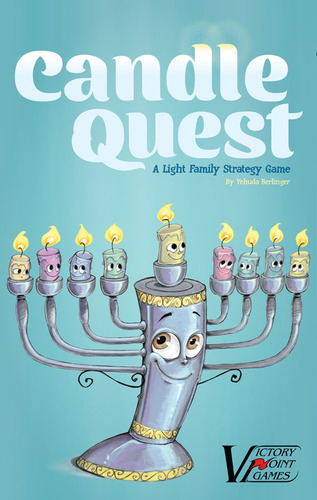
CandleCoverToday we're talking with Yehuda Berlinger, designer of It's Alive!, and the recently released Candle Quest, which uses the same mechanics in a game about Hanukkah.

Yehuda, thanks for taking the time to chat with us!

Happy to oblige.

Candle Quest, the original theme of the auction game It’s Alive!, has finally been released by Victory Point Games. Was the theme/holiday the motivation for the game? Or were you creating an auctioning game and looking for a theme to work within?

The original original theme was actually an “electrical safety” game. The eight items you needed to collect were safety tips for handling electricity. The idea of collection came pretty easily, and the idea of three simple choices on each turn, and there being an auction, was inspired by the simplicity of Reiner Knizia’s designs. I hadn’t seen any games where the auction didn’t come back to you, so I went with that. It turned out to be a new and interesting mechanic.

After I completed the first version of the game, which didn’t take long, the people who asked me to do the game said that the opportunity with the Israel Electric Company had passed, but that they might be interested in making the same game with a different theme, something to do with space aliens. They created a mockup with stock alien pictures in spaceships. After very little development, they offered me a small sum for the game, and I said I would have to think about it. Less than 12 hours later they had decided to work with someone else to make a game instead.

My game group and I, especially my friend Nadine Wildmann, played around with the game again, changing some more rules (making the bad cards less bad, mostly) and tossing around ideas for collection themes, including eight candles for a menorah, eight reindeer for Santa’s sleigh, etc. Eventually I did a mockup for The Menorah Game and took it to BGG.con in 2005 in order to sell the game to publishers. I brought prototypes with me to give to publishers, and I mailed some out, but BGG people bought all of the rest of them (even though they were pretty crappy).

I don’t remember the path that got from there to Jackson Pope at Reiver Games, but eventually it did, about a year later. He changed the theme to Frankenstein and the name to It’s Alive, and added cartoonish gory pictures, assuming that such a theme would sell better to gamers than a menorah-themed game would. He was probably right, but it also limited the audience to gamers, and older ones, in my opinion.

After I got back the rights, Jeremy Maher asked me to license him the game to make an app, which is currently available in both Android and iOS editions.

What was still needed was a game that would appeal to non-gamers and families. Nadine and I, as well as friends of ours Bill and Shirley Burdick, tossed around some more ideas. Turns out that Bill, Nadine, and I were all working on new games, and we thought it would be good to publish It’s Alive again in a more family friendly version as part of a new company, which we called Gilead Games. The new game would go back to the Hanukkah theme. This would appeal to Jewish families, since there are no other good Hanukkah games available, and hopefully to all families, since there is little Jewish about the game other than the fact that it has a menorah and the coins are called shekels.

Nadine did most of the work; Bill, Shirley, and I provided encouragement.

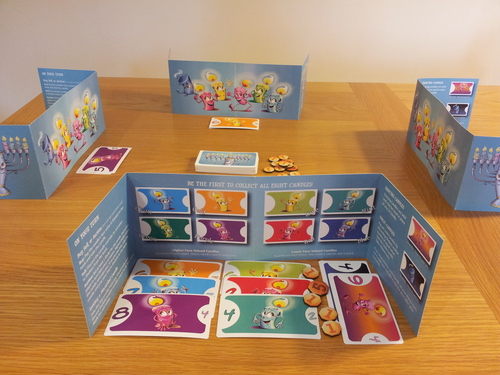
candlesetupBefore Victory Point Games picked up Candle Quest, you made an attempt at bringing the game to market via Kickstarter. What did you learn through that process?

Well, I actually learned a lot from the article I wrote on Purple Pawn (How to Succeed or Fail on Kickstarter), and we knew that we would either get to 10% funding within 24 hours or we would probably not succeed. I thought that I had enough people who would be interested because many people know my blog and BGG persona. Unfortunately, most of these people are gamers who already own It’s Alive (or don’t want to) and are not the target audience for Candle Quest.

A smaller amount of support came from friends, family, and synagogue members, but it was quickly clear that this was nowhere near enough. Your fan base really determines the type of support you can expect on KS. We had a mismatch between the game we were making and the audience that needed to support it.

I think the audience for Candle Quest is HUGE. There is simply no other good original Jewish-themed game, anywhere, other than something like Jewish-themed Apples to Apples or Jewish-themed Chess, etc. Candle Quest is a gateway game with crossover appeal to non-gamers and easy for kids to play, but a real solid game for Eurogamers and adults. It’s not for everyone, of course, but so far about 80% of the people who play it like it, and some are real fans who want to play it over and over. It plays quickly and rewards experienced play without letting experience dominate.

So the simple republishing of the game through VPG is not the end of the story, but just the beginning. We have to get the game out to Jewish distributors and stores and hopefully hit a tipping point where it catches on with the public (and friends tell friends, etc). The KS process helped us focus all of that: how to estimate the publication costs, how to figure out the market, etc. And in the end, how to find the right publisher.

Now that Candle Quest is published, what’s next for you?

I hope Candle Quest will come out as an app, like It’s Alive did, and I see no reason not to also use the base game to create the Santa’s reindeer version, or other themed versions, for that matter.

Nadine is currently showcasing her own board game prototype to publishers and Bill is polishing up an RPG he created that has gone through extensive playtesting. He/we are considering how to change its theme to something biblical, since we think Gilead Games could occupy a niche as a publisher of biblically themed games. There are some publishers of Jewish games, but they publish bad games or re-themes of other games, and there are some publishers of Christian games, some of whom are not bad. But it’s still a large market with few serious players.

We’re a talented bunch of people with some good ideas, and we’re having fun with the ideas.

What are some of your favorite board games right now?

I love Go, though I’m bad at it, and I’m still a huge fan of Puerto Rico. I also love Bridge and other partnership card games like Tichu, Anagrams, and Scrabble; Magic: The Gathering (but only for fun playing with random cards, not constructed), and the other games I rate highly on BGG of course.

How is gaming different in Israel than here in the States?

I’ve written about this a few times. It depends on what you mean by gaming.

For Eurogames, we have some loosely organized forums and groups and about a 500-1000 players. If you include Settlers of Catan, Munchkin/Steve Jackson Games, and Fantasy Flight Games (i.e. the publishers who actually have reps in Israel), the number would jump to something like 3-5,000, I estimate. Add CCGs and RPGs, and you’re talking about 10,000.

But most gaming here refers to the classics. We have huge amounts of Chess and Backgammon players, a few large Bridge and Scrabble clubs, and a lot of people playing Monopoly, Taki (like UNO), and other bad games, many of which have Jewish or Moslem moralistic themes.

Access to Eurogames and CCGs is hard, and so expensive, because the market is small so it all has to be shipped, and taxes are high (VAT on everything sold).

Language is a barrier, since most people read Hebrew or Arabic, and while many adults can get along in English, they would prefer not to have to. So many importers try to provide the games with Hebrew instructions or republish the game in Hebrew. I don’t know much about the Arab market, but some Moslem populations, like some ultra-Orthodox Jewish populations, frown on the imported culture, lack of modesty, and fantasy themes that are prevalent in board games.

Ok, the rapid-fire section! We ask the questions; you answer them with one word (or super-short phrase)! And, GO!

Favorite movie with a numeral in it?

Terminator 2

Fairytale+5168Favorite Bob Dylan album?

Fairytale by Donovan. :-)

Last meal on death row?

All you-can eat Chinese with an unlimited time to eat it? What am I doing on death row? Help! Probably fasting, since that is the appropriate Jewish action for doing penance (like on Yom Kippur).

Favorite character in a TV show?

Lorelai Gilmore

Last great book you read?

Yoreh De’ah of the Shulchan Aruch :-)

Ok, The English Patient.

Thanks for answering our questions, Yehuda! And thank you for reading! You can check out Candle Quest right here.

Suburbia—A Review

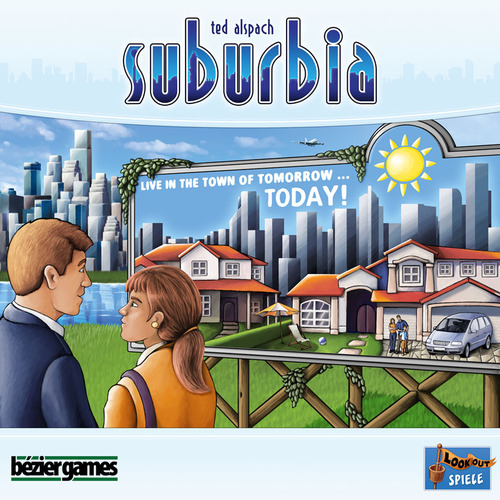
suburbiacoverBy Firestone Confession time: I've never been a big fan of Civ games. Not board games. Not video games. Not any games. They're...boring. So Suburbia comes out, and lots of people call it a SimCity board game. This fills me with dread, and a desire to take a long nap... Could this be the first civ/city-building game I like? Or will I build a Landfill and then put this game into it? Let's find out!

The Overview

You're going to be taking, paying for, and placing tiles into your city. Doing so will affect your income and population. When the game ends, whoever has the most population wins.
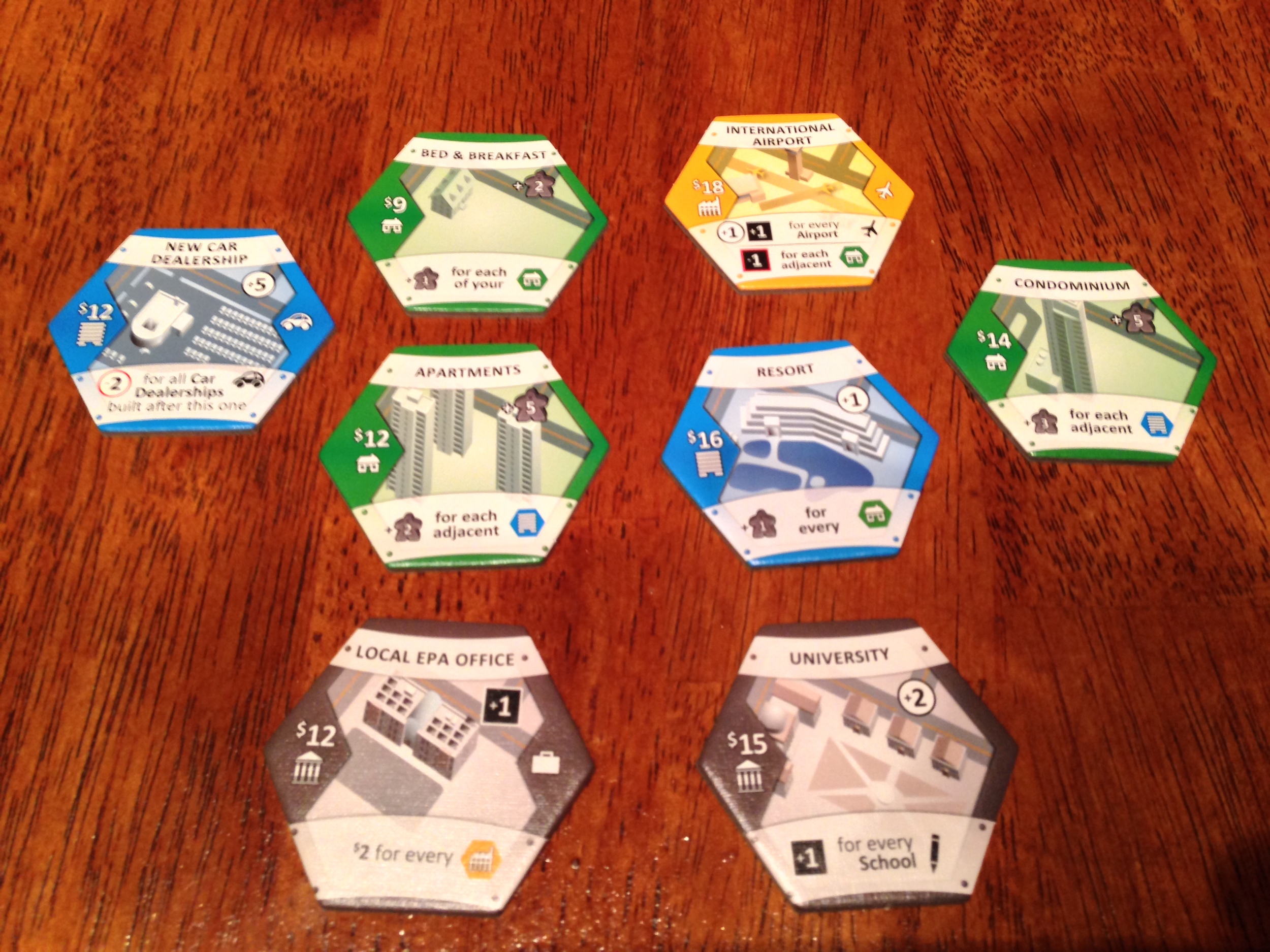
suburbiaTilesThe Components

1 Population board

1 Stacks board

1 Supply board

1 Real Estate board

4 Burrough boards in the player colors (black, red, purple, yellow)

144 hexagonal City tiles

20 Goal tiles

4 Player aid cards

1 Start player marker

1 Giant pile of money tokens

4 Reputation markers

4 Population markers

4 Income markers

12 Investment markers

The Setup

The City tiles are divided into four groups: Basic tiles, A, B, and C tiles. Separate the A, B, and C tiles (they have the letter on the back side), and then you'll place a number of them on the Stack board. (This number varies depending on the number of players.) In the C pile you'll also be mixing in the One More Round tile, which will trigger the end of the game.

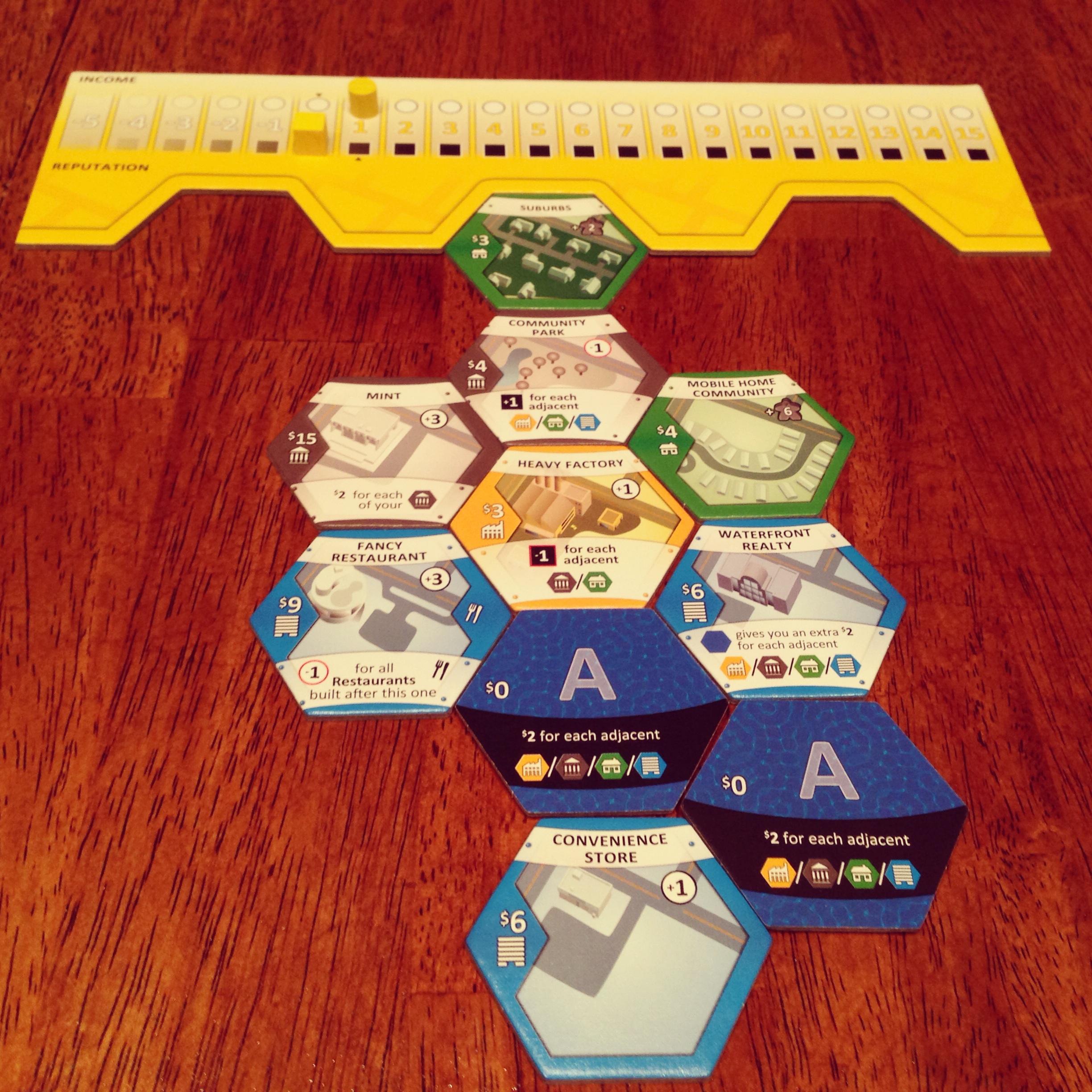
Place money on the Supply board, and give each player $15 million. Place the basic City tiles (Suburbs, Community Park, and Heavy Factory) onto their spaces on the Real Estate Market board. Then place the top seven tiles from the A stack out onto the Real Estate Market. These spaces range in price from $10 on the top end, and free on the bottom.

Then shuffle the Goal tiles, and place a number of them out, faceup, depending on the number of players in the game. Then give each player two Goal tiles facedown, and each player chooses one to keep and places the other back in the box with out showing the other players.

Each player takes a Borough Board, places the Income marker on the 0, and the Reputation marker on the 1. Each board is flat across the top and has three "notches" for tiles to fit (see the picture). Each player takes one Suburb, one Community Park, and one Heavy Factory from the basic City tiles, and places them in that order, from top to bottom, in the middle notch of the Borough Board.

Finally, (whew!), each player grabs his or her set of three Investment markers, and places their Population square on the 2 space of the Population board. You're finally ready to play! It seems like a lot of prep, but it's intuitive, and goes fairly quickly.
suburbiaThe Gameplay

Randomly choose a start player. You can do one of two things on your turn: take and place a tile into your Borough, or place an Investment marker.

If you choose a tile from the Real Estate Market, you pay the cost on the tile and the cost of the tile's "position" in the Market. So as tiles are in the Market longer, they become cheaper. But, of course, the tile might be gone by the time it rolls around to your turn. So do you pay more now, or wait and hope it's still there? That's one of the interesting decision-points in the game.

You can also choose to buy one of the basic City tiles, and you just pay the cost on the tile.

Once you have a tile, you place it into your Borough. The only real restriction on placement is that the new tile has to touch at least one side of an already placed tile. Then you'll often have some adjustments to make based on the tile. So it might increase or decrease Income, or Reputation, or just give you some quick cash. You placing a tile might also trigger someone else's tile already in play. So the Homeowner's Association tile, for instance, gives its owner $2 every time any player plays a green Residential tile.

One other option for placing a tile is to make a Lake. You have to pick a tile from the Real Estate Market, and you pay the position cost only. Then you place it in your Borough, and get $2 for each adjacent tile that's not another Lake. It's a way to get some quick cash—and swipe a tile from the Market that you know someone wants.

The other option is to place one of your three Investment Markers. Instead of taking and placing a tile, you pay the tile cost of your chosen tile again, and then place a Marker on it. Now the effects of the tile are doubled for the rest of the game.

At the end of your turn you'll now receive (or pay) money, based on the position of the Income Cylinder. If you can't pay when you need to, you have to move the Population Square down one spot for each dollar you can't pay.

Now you adjust the Population Square up or down based on the position of the Reputation Cube. As your Borough and Population grow, you'll have to pay more to maintain it. There are red lines on the population track, and whenever you cross one, you reduce your Income Cylinder and Reputation Cube down one spot. If you ever end up going back below a red line (due to negative Reputation, for instance), you'll put the Income and Reputation back up one spot.

If you bought a basic City tile, or placed an Investment Marker, you must remove any tile from the Real Estate Market—paying the position cost only. So one tile will be removed from the Market on each player's turn. Now you slide all of the remaining tiles down—making them cheaper—and place a new tile on the leftmost position.

When the "1 More Round" tile comes up, you finish the current round and then play...one more round. Now you look at Goals, and then turn money into Population—you ignore the red lines from this point forward.

First you check the faceup Goal tiles, and award the points to one player. If there's a tie, no one gets any points. Now each player reveals his or her secret Goal, and scores the points if they've achieved the goal themselves. Again, if you've tied, you don't get the points, and only the owner of the secret Goal gets a chance to get those points. Finally, you'll turn money into Population at the rate of 1 point for every $5, rounded down. (Keep any leftover money, as that's the third-level tiebreaker.)

Some of the Goals include "+10 for the most airports," or "+20 for the fewest Residential tiles," or "+20 for the lowest Reputation."

Whichever player has the most Population wins. If there's a tie, it's the person with the highest Reputation, and then the highest Income, and finally most leftover money.

There's also a Solo Version, where you're playing the 2-player version against a "bot" player.

SuburbiaGoalsThe Verdict

I love this game. It hits all of the right buttons for me: It's thematic, full of interesting decisions, has an auction with more meaningful decisions, includes Goals you're working toward, and just...yeah!

Let's get this out of the way: There are a couple of things I don't like. First, with so many tile interactions going on each turn, it's easy to feel that someone at the table has missed a bonus somewhere—but that's a small complaint.

The larger issue is the Goal tiles. Those are a lot of points, and it's fairly easy for someone to unintentionally interfere with your Goal. For instance, in a recent 2-player game my opponent had a hidden Goal of "+20 for the most lakes." Unfortunately for him, I seemed to be constantly broke, so I kept buying lakes for some quick cash. So those were 20 points I "stole" from him, and I had no idea I was doing it. Even worse are tiles like "+15 for the fewest played Investor Markers." There is nothing you can do to control whether other players play their Investment Markers, so if even one person chooses not to play one, you're just out those points. It's kind of a big deal, but this is one of those games where the other parts are so good that I overlook this flaw.

Okay, now that that's out of the way, let's go back to the good stuff.

I've played this with every number of players, and it scales well. I especially like the 2-player game, because as you add players, you increase the chances of someone messing with your hidden Goals—although I do like having more people trying to win the public Goals. Okay, I like every number! I also like that it's on the lighter end of the spectrum, while still creating meaningful and interesting decisions. One reason I dislike Civ games is that there's just so much going on. This isn't a light game, but it also doesn't overwhelm you with minutia. I played with my 9-year-old, and he did just fine. It's a good next-level game for him. And though I have yet to test this, I think this would actually be a pretty good nongamer game.

The theme is really strong here, and it comes through in small touches. For instance, if you build a Landfill, you'll increase your Income, but for every building you build it next to, your Reputation will decrease. And every single tile has these thematic touches that make sense and make the game fun and interesting. And because you're not using every tile in every game—and there are different Goals in every game—no two games will feel the same.

I like laying tiles. This might be because one of my first Euros was Carcassonne, but I just like laying tiles, and deciding where the best place to put a tile is. But it's not just laying tiles, because there's also that wonderful Market. "That's a great tile, but it's expensive. Will it still be there when it gets to my turn again—and when it's cheaper?" "Should I turn that tile into a lake to keep it away from her?" Every turn has these sorts of decisions to make, and I enjoy doing that.

Another good thing? Combos!!

The game plays quickly, even with the full complement of players. And a 2-player game can be played in 30-45 minutes, so it's really a meaty filler. I love that.

The Final Verdict

I know I seem to be gushing over this, but I'm completely taken with it. I LIKE playing this game. There are a lot of great games that I wouldn't personally say are "fun" (Dominion springs to mind), but this one is fun for me. It's hasn't even come close to getting old, and I don't think I'd ever turn down a game. Bezier Games just came out with a expansion, and I can't wait to see what they do to expand this. It's one of my favorite games I played this year. Put this on the table!!

Theology Of Games would like to thank Bezier Games for providing a review copy of Suburbia. This in no way affected our opinion of the game.

Thanks for reading! Have you played Suburbia? Did you agree with my review, or do you think I should build a lake and then jump in it...? Let us know in the comments.
Christmas Present Idea: Geeky Ice Cube Molds

d20icecubeHow cool is this?! Thinkgeek is selling some fun ice cube molds—one is a d20, and one is the Death Star.

They're two-piece molds; here's how they work:

To freeze: Fill bottom half of mold up to seam. Put top half of mold on (match notches). When frozen, remove from freezer. WITHOUT removing the top, fill the rest of the way (but leave a little space) and put back in freezer. Because of the magic of water molecules (and how they expand when frozen), this method prevents the mold from leaking.

deathstaricecubeDishwasher-safe. Relatively cheap. Super-geeky.

Here's the D20, and Here's the Death Star one.

Thanks for reading!