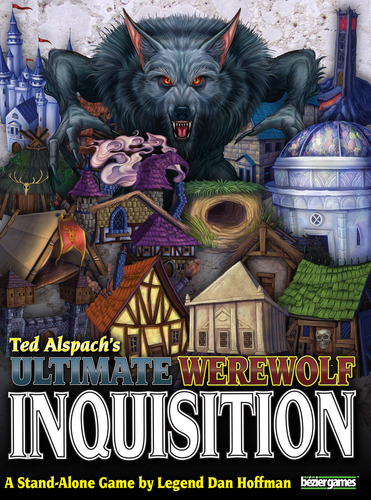

Ultimate Werewolf: Inquisition—A Review

WerewolfCoverBy Firestone I've never been a big Mafia/Werewolf fan. It can be an incredibly fun time, but the player elimination means some people are always sitting on the sidelines waiting. And the bigger the game, the longer you're waiting... So when The Resistance came out—and there was no player elimination—I jumped at it. And it's now my favorite game.

Ted Alspach and Bezier Games recently released Ultimate Werewolf: Inquisition, which promises some of the hidden roles and gameplay of Werewolf, with no player elimination. I'm intrigued. Will it knock The Resistance off the throne? Let's see...

The Overview

Ultimate Werewolf: Inquisition is part of the line of Ultimate Werewolf games that are coming out under Ted Alspach's Bezier Games. It plays 3-12 players, and is for ages 8 and up. It takes 30-60 minutes to play. One "side" will win—either the werewolves, or the good guys.

The Components

1 Rulebook

12 Inquisitor cards, with either a Werewolf or a Villager on them.

19 Hut cards, which are the "houses" that belong to the Residents in the game. Each one imparts some special action.

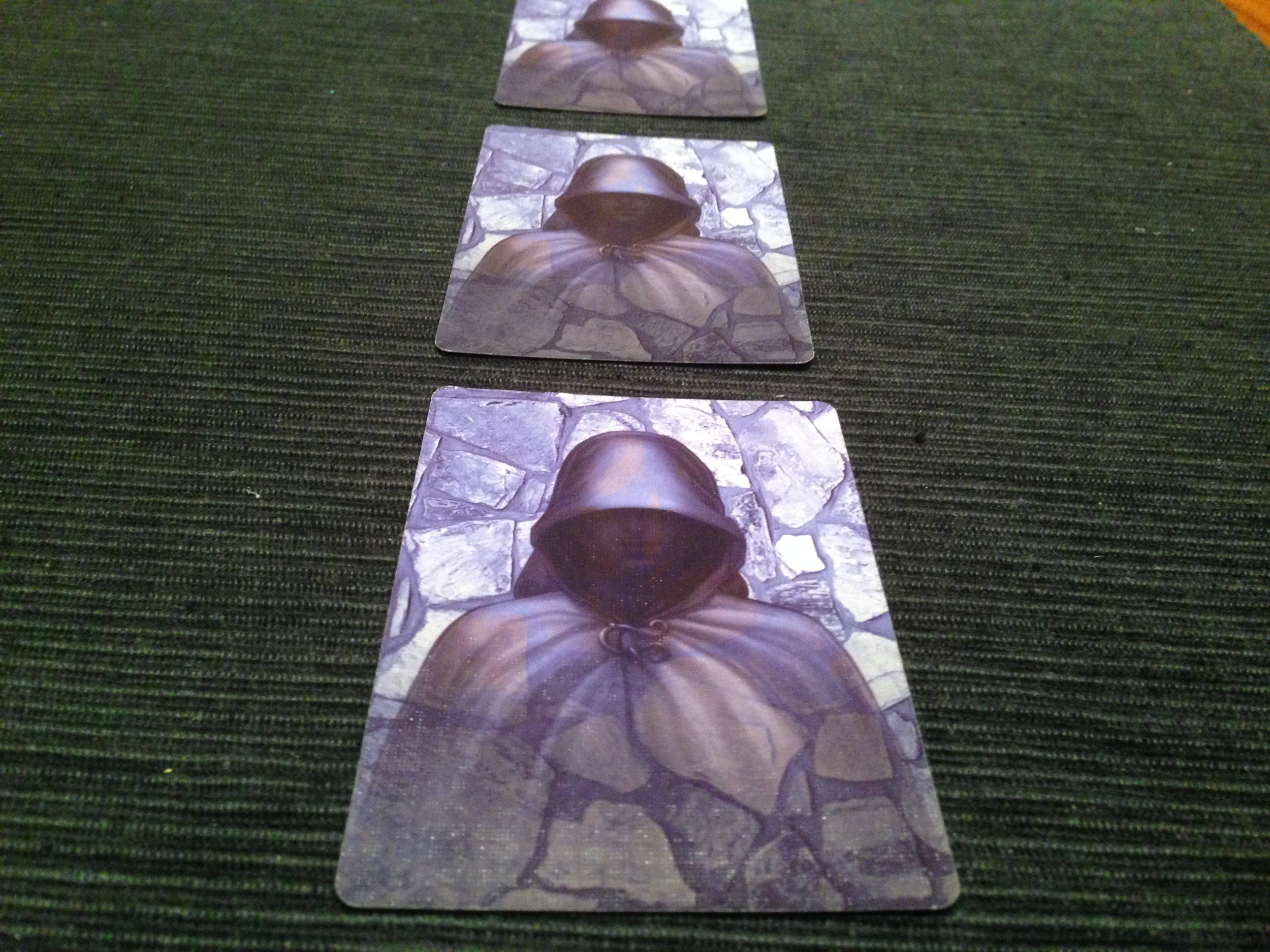
19 Resident cards, which match up with the Huts—there's one person card for every Hut card.

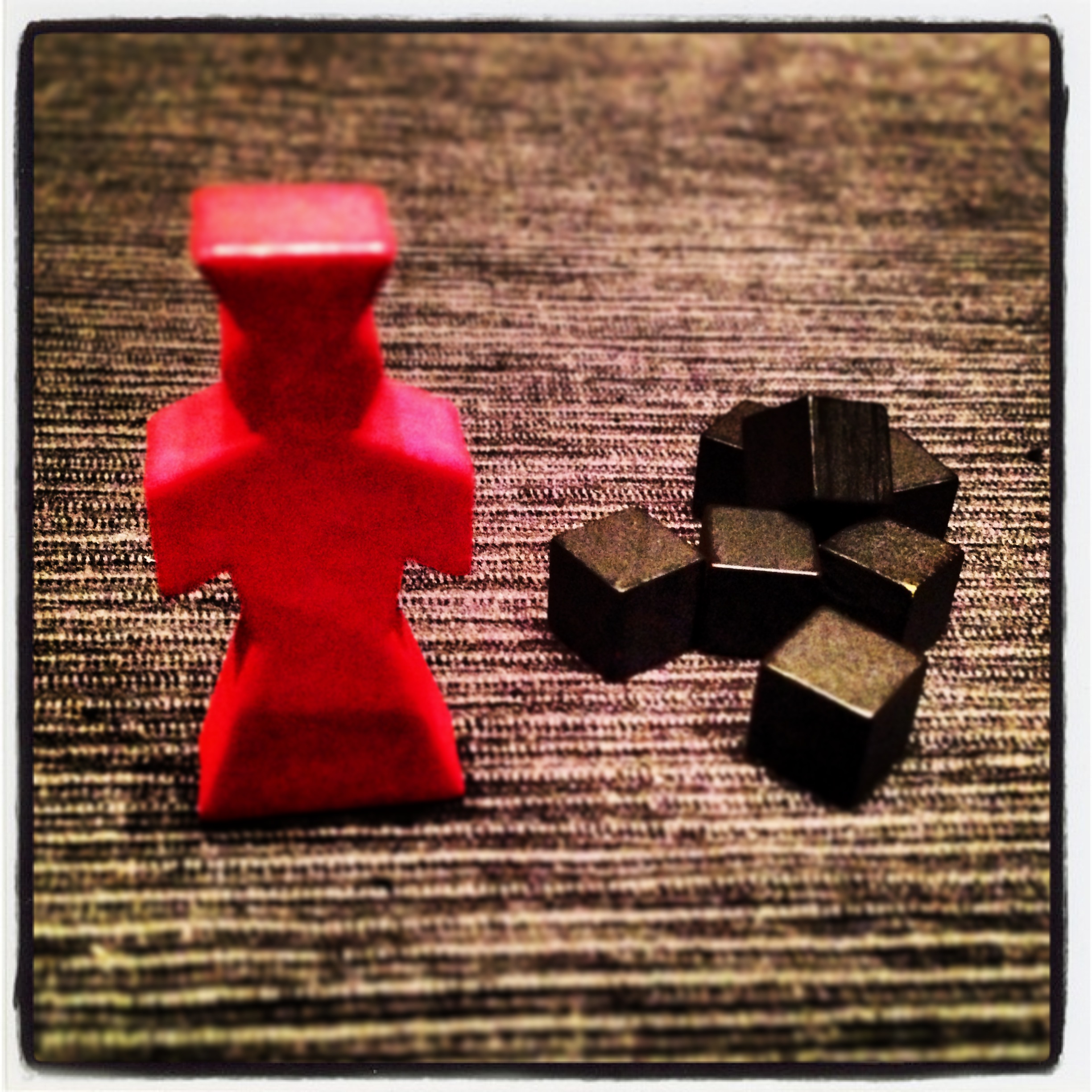
1 Grand Inquisitor meeple

50 wooden voting cubes

There's a distinction between Residents and Villagers. All Villagers are Residents, but not all Residents are Villagers—some are Werewolves...
WerewolfVotesThe Setup

First you'll hand out Inquisitor cards; this will vary depending on the number of players. A 3-player game has 1 Werewolf and 2 Villagers, up to a 12-player game, which has 5 Werewolves and 7 Villagers.

Then you decide which set of Resident/Hut cards you'll use. There's a whole section in the rulebook that recommends sets based on number of players, or if this one of your first games. The Resident cards also have positive or negative numbers on them, which allow you to try and find a good balance of cards (in which case the numbers will add up close to zero), or to skew things one way or the other if you find one side winning too often—higher numbers to help Villagers and lower numbers to help the Werewolves.

You'll set up two areas of your chosen sets. One grid of four across and three down with the Huts—faceup so the Huts and their powers are visible. Then you shuffle the Resident cards and create another four across and three down grid—facedown, so you have no idea which Resident is under that card. The important thing here is that there is one Resident for every Hut card, but their orientation in the grids is NOT identical.

Choose a random player to get the Grand Inquisitor meeple, and then give each player two voting cubes to start the game.

WerewolfHutsThe Gameplay

On the First Night, whoever the Grand Inquisitor tells everyone to close their eyes, and has the Werewolves open their eyes so they know who the other Werewolves are—this is skipped in a 3- or 4-player game since there's only one Werewolf.

For the Day Phase, each player, starting with the Grand Inquisitor, chooses a hut and either does the action on the hut, or takes two voting cubes. Either way, that hut is no longer available to choose that turn. As the game progresses there will be fewer and fewer huts, thanks to people being killed, so if there are no huts available, you just take two voting cubes. After everyone has chosen a hut, everyone gets a chance to vote on which Resident to kill. Starting with the Grand inquisitor, everyone who has a voting cube has to place one on a Resident; if you don't have a cube, you don't vote. Whichever Resident has the most votes is killed—remove the Resident and the associated Hut from the game. If there's a tie on votes, the Grand Inquisitor breaks ties.

If two columns have a single Resident left in them, they're combined without changing their orientation. (Some actions on Huts will change the orientation from vertical to horizontal.)

Now come the Night Phase. The Grand Inquisitor chooses a column that has two or more cards in it, and removes any votes on them. He picks them up and puts them in a stack keeping them in a strict order—we always have them stack the top card of the column on the one below it, and then those on the one below that (if there are three). This is important because now everyone closes their eyes and passes this stack around the circle. The person to the left of the Grand Inquisitor starts with the stack. If she's a Villager, she keeps her eyes closed and just makes some shuffling noises with the cards but doesn't change the order in any way. If she's a Werewolf, she can open her eyes and change the order of the cards. Each person will say the name of the person they're passing to—or just say "Passing," or whatever—and for a brief moment those two can open their eyes just to make the exchange, but then Villagers have to close their eyes, lest they see a Werewolf turn the cards over and start rearranging. The cards will eventually make their way back to the Grand Inquisitor, who will shuffle or rearrange or not, and then everyone opens their eyes. The Inquisitor then places them back facedown in the column in the same order they were taken: bottom card on the bottom of the column, then the next above that, and the next at the top.

All of this keeping-things-in-order stuff is important because whatever Resident is at the bottom of that column is killed. The Werewolves set it up.

The actions here are admittedly very clunky. This phase shouldn't be a way for Villagers to figure out who the Werewolves are, which is why everyone makes noises and shuffles the cards around as though they were rearranging them. In essence, everyone should "act" like a Werewolf so that no one is outed as a Werewolf because they made noises or took longer than anyone else or whatever. Clunky.

If a Werewolf is killed in this phase, remove votes from all vertical Residents and shuffle them together and deal out a new grid. This is because if a Werewolf is killed at Night, then it's because that column had nothing but Werewolves and they had no choice but to kill one of their own. So the shuffling evens things out again.

A new day starts with the Grand Inquisitor getting passed to the left, and columns with only one Resident getting combined. The game ends when either all of the Werewolves are dead (the Villlagers win), or of there are more Werewolves in the village at any time than there are Villagers—in which case the Werewolves win.
WerewolfResidentsThe Huts

I'll go over the Huts and their special abilities. The number in parentheses is the number you use when you're trying to balance (or not unbalance) your choice of Residents in the game—high numbers help Villagers, and low ones help the Werewolves.

Villager/Werewolf (+0)—Take two voting cubes from the supply, and place one of them on any Resident.

Seer (+8)—Look at any vertically oriented Resident, and place it back in the same spot, but oriented horizontally. Neither the Seer (in subsequent turns) nor the Apprentice Seer may look at this card until something changes its orientation back to vertical.

Apprentice Seer (+5)—Pay one voting cube to look at any vertically oriented Resident, and place it back in the same spot, but oriented horizontally. Neither the Apprentice Seer (in subsequent turns) nor the Seer may look at this card until something changes its orientation back to vertical.

Bodyguard (+2)—Protect one Resident by removing all voting cubes from it, and placing the Bodyguard Hut on that Resident. No more votes can be placed on it this round. Remove the Bodyguard at the start of the Night Phase before a column is chosen to pass around.

Hunter (+1)—Take three votes from the supply and place them on one Resident.

Mason (+3—Pay two voting cubes to look at the Inquisitor card of another player. You can't show the card, but you can say whatever you want about it. (This role shouldn't be used in games with fewer than 5 players.)

Minion (+3)—Take two votes from the supply and place both of them on a Resident card that already has at least one vote on it.

Mayor (+1)—Immediately give the Grand Inquisitor to any player (including yourself). This changes who will start voting, and who picks a column of cards to pass around. The Inquisitor gets passed to the left at the end of the turn, as usual.

Prince (+3)—Take four votes from the supply.

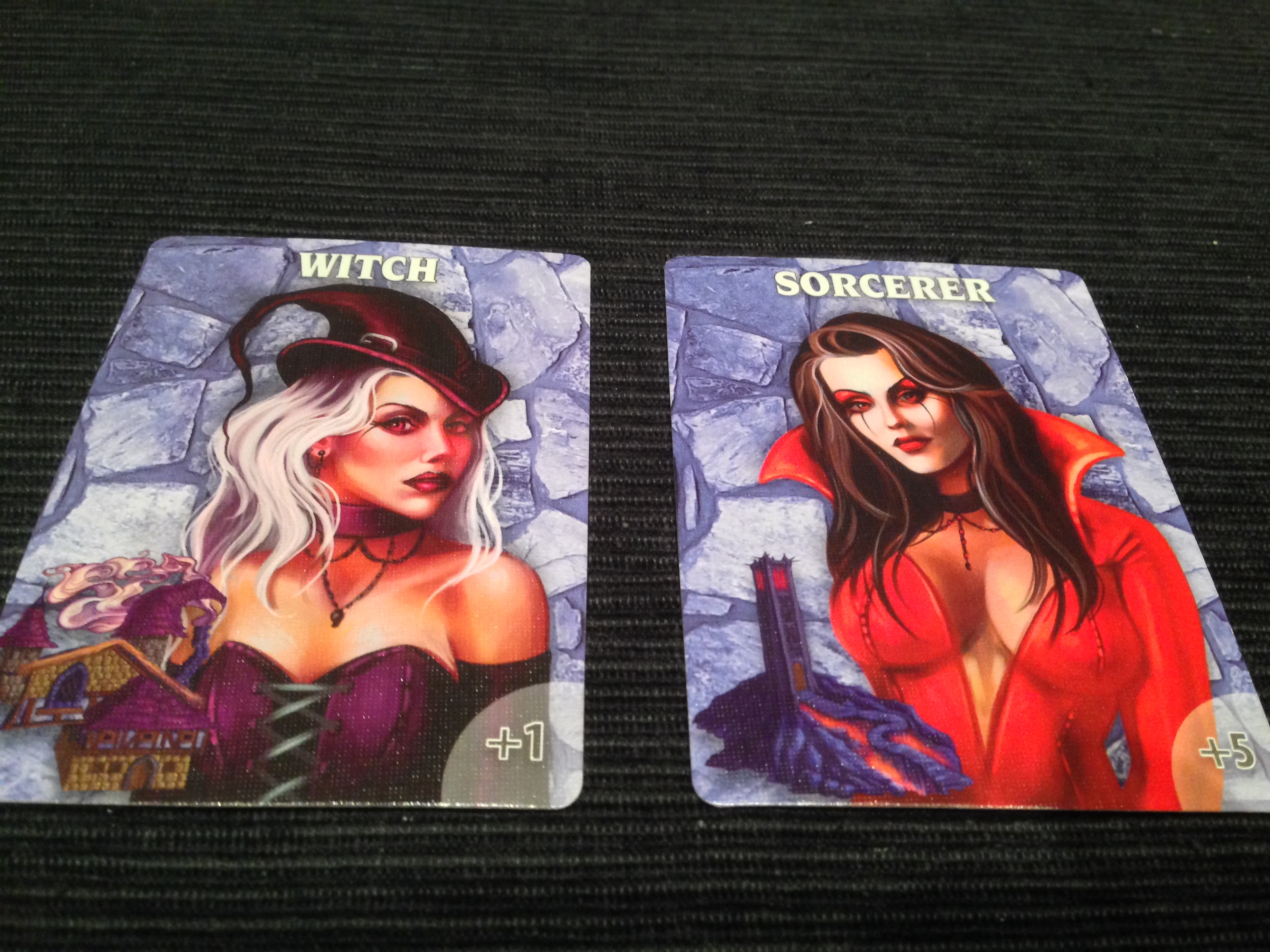
Sorcerer (+5)—Look at any horizontally oriented Resident, place it back in the same orientation, take two votes from the supply, and place them on the card you just looked at.

Witch (+1)—Move all votes from Resident card to any other Resident card.

Cursed (-1)—Take four votes from the supply. If someone uses the Cursed Hut during the day, and that Resident is killed that night, it becomes a Werewolf. That column's cards (and the Cursed) are shuffled and placed back in the column. The Cursed acts as a Werewolf from that point forward—including determining numbers of Werewolves for victory.

Troublemaker (-5)—Pay one vote to shuffle a row or column of Resident cards. First, set aside votes on those cards, but keep them near the spot they were on. Shuffle the cards, place them back vertically, and then place the votes back onto the card that is now in the spot.

Wolf Cub (-2)—Take three votes from the supply. If the Wolf Cub is lynched on the day someone uses the Hut, the Werewolves get to kill two Residents that night. You do one round of picking a column, passing it, and killing the bottom Resident. And then you do that all over again. The Wolf Cub is not considered a Werewolf.
WerewolfWomenThe Verdict—I like this game—probably more than I should, honestly. The game plays any number between 3 and 12; I've played with as few as 4 and as many as 10, and there are upsides and downsides with those extremes. It actually plays surprisingly well with the low number; you can't play Resistance with 3 or 4, but you can play this. With the higher numbers, it's cool because there are more Werewolves, and more interesting Residents, but it also has its own problems. In our game, one player was a player or two to the right of the starting Grand Inquisitor. And then, because of where we'd figured some Werewolves were, we kept taking the Mayor and keeping the Inquisitor in that area. It worked well for the Villagers, but over the course of the game that guy had very little to do on his turn. Early in the game, the only Residents left were the generic Villager/Werewolf Huts, so he was forced to take those. Then as the game progressed and people died, when it would finally get around to him there wouldn't be any Huts left, so he just took two voting cubes. He was pretty dang bored, and it wasn't the group trying to keep him out, it was the game's mechanisms creating that for him. It could have happened to anyone, and it probably won't happen every game, but it happened that game, and his experience was poor.

It's very interesting that—unlike a game such as The Resistance, where getting outed means you're essentially done—getting outed as a Werewolf here (or even outing yourself!) isn't the end of the world. There are times where revealing yourself is necessary to save one of your Werewolf residents. But you're still in the game, and there are still things to do and ways to mess with the Villagers. They can't shut you down, but now they have to adjust their play to keep you away from certain powerful Huts, such as the Mayor. It feels weird that being revealed isn't bad, but I think it's interesting.

I've noticed that every single game seems to come down to the wire, and I think the game sort of forces the game to even out and stay close until the end. I'm not sure how it does it, or even if its intentional, but we haven't had a blowout in any of the half-dozen games we've played. The downside of this is that a couple of times the win has come down to mostly blind luck and guessing. That hasn't always happened, but when it does, it feels a little unsatisfying.

As I said, the Night Phase is clunky. Having to have everyone shuffle the cards around, and spend extra time doing it, and making noise just feels weird, but I have no idea what else they could have done. So while it's not great, it's fine in the end.

I do feel I should make mention of the artwork. Most of it is fine and completely innocuous, but the Witch and Sorcerer look more like two ladies who just went shopping for Halloween and decided to grab the "Sexy Witch" and "Sexy Sorcerer" costumes. The Sorcerer especially looks like Kate Upton in a black wig. They're not terrible, but it's just something to consider, and I felt I needed to point out. It's disappointing to see a publisher going that route on what should be a family friendly game. And if they bother you that much you can always choose not to include those roles in your game.

So who would I play this with? Well, it often goes as long as a game of The Resistance, and I would always choose The Resistance over this. If I only had 3 or 4 players, I could see pulling this out with my game group, but we're big-time Resistance fans, so that wins. I would bring this out with nongamers, though—in a heartbeat. The Resistance is very different, and takes some time to understand what you're doing and how much you should be talking and voting and just so much... But this would be a GREAT game to ease people into that sort of game. There are hidden roles, but it's not a disaster if you play it "wrong" and out yourself. And the gameplay is fairly straightforward. And it's short. All of this means that this is going onto my short-list of games to play with nongamers, newbies, and youth groups.

And if your group really likes to play Werewolf, they'll probably like this! It's maybe not as purely social as traditional Werewolf is, but it has some of the feel, and there's no elimination.

The Final Verdict—Ultimate Werewolf: Inquisition isn't perfect, and it will never replace The Resistance for me or my game group. But I like it. I like what it tries to do, and I like what it accomplishes, and I have a fun time while I'm playing it. It's at a perfect level for nongamers, and it will be the game I use to ease my family into this style of game before I eventually spring The Resistance on them... And since there are only 4 of us in the family, we may never get to The Resistance, so this may be it. And that's okay, because it's a solid game.

We'd like to thank Ted Alspach at Bezier Games for providing a review copy of Ultimate Werewolf: Inquisition. This in no way affected our opinion of the game.

photo-332.jpg

IOS Board Games: One on Sale, and One Free!

kingdomApple announced some new iPads yesterday. What better way to celebrate buying one than by getting some cheap games for it?!

Kingdom Builder—the clever game by Dominion designer Donald Vaccarino, is on sale for $4.99 (normally $6.99). And the abstract game Hive is FREE (normally $.99). They're not huge savings, but if you just dropped some bones on a new iPad, every little bit helps! Who knows when these will go back to regular price, so grab them now!

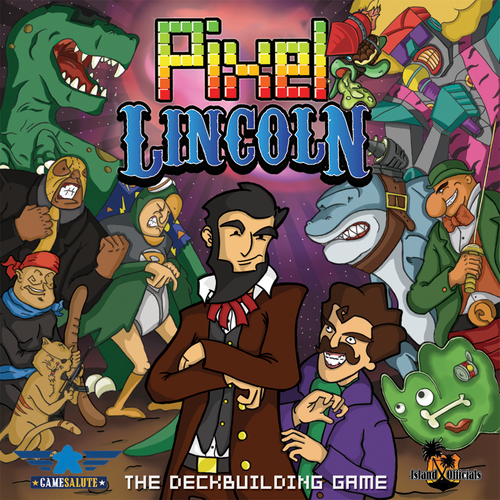
Thanks for reading! And don't forget to subscribe to the Theology Of Games Podcast on iTunes. We're giving away a copy of Pixel Lincoln, and the details are in podcast #3! Bye!

Podcast #3 and a New Contest—We're Giving Away Pixel Lincoln!

pixelcoverHey everyone! We're super excited about everything that's moving and shaking here at Theology of Games. We're happy to announce that our third episode of the Theology of Games Podcast is up and running and available for download on iTunes!

We were joined this month by the effervescent (Jeremiah wrote that. Weird.) Jason Tagmire, designer of Pixel Lincoln, Maximum Throwdown, and more! He was kind enough to chat with us about his games, and a little bit of what is coming down the road for Pixel Lincoln.

But wait! There's so much more! During this episode of the podcast, we give you all the details on how you—yes YOU—can win a free copy of Pixel Lincoln of your very own! Want to win? Listen to the podcast, or, check out the Web for clues about the contest! I know...super mysterious, right?

You can click this link to download your own copy of the podcast; we would love it if you subscribed and shared it with your friends!

Thanks for reading, watching, and listening!

photo-332.jpg

Last-Chance Kickstarter Project: Buccaneer Bones

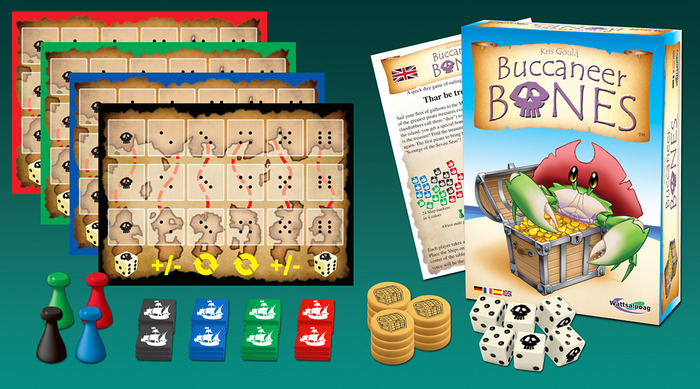
buccaneerbonesHey, we just found out about a neat-looking project, but it ends in just 48 hours! So we're going to give it its own post. It's a push-your-luck dice-roller, and it's only $9 shipped!

The game comes with:

-    4 Player Maps

-    4 First Mate Pawns (Plastic)

-    24 Ship Markers (Uria Stone Plastic, similar to Backgammon tiles)

-    12 Treasures (Uria Stone Plastic, similar to Backgammon tiles)

-    6 Bones (Dice)

-    Rule books in four languages (English, French, German, Spanish)

You roll dice, and try to get to islands and plunder them. And there are some special powers that activate depending on which island you're on. It's not deep. It's not strategic. It's not Tigris & Euphrates. BUT IT'S ONLY $9 SHIPPED. That's a great deal, even if you only use this with nongamers or teenagers or at an after-school program or whatever. Plus, they're only $3,000 away from adding two players to the mix. Check out the campaign, but do it soon, because there's only ~38 hours left!

Thanks for reading!

photo-332.jpg

Kickstarter Weekly—October, 18, 2013

Hey gang, it's been an exciting week around here, we just recorded our third episode of the podcast, and it should be showing up in your feed sometime really soon! Meanwhile, Kickstarter is doing its thing, so let's take a look at what's going!

Featured Campaign!

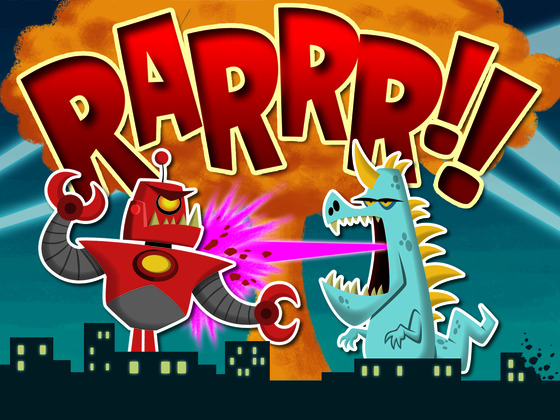
RarrRarr —Ape Games

Our featured campaign this week is a fun-looking family game in which players create their own monster with a unique set of powers, and then pit them against other players' monsters in a battle royale!

The campaign ends Nov. 25,  and it costs $20 for a copy of the game. You can check out the campaign here!

Space JunkSpace Junk—Lamp Light Games

Get ready to grab all that junk flying around in space and patch together your own rocket ship, and battle your friends in this light strategy board game. This one looks interesting, but the campaign is off to a slow start.

The campaign ends Nov. 11 - $40 Canadian gets you a copy of the game—check out the campaign here!

Run Fight or DieRun, Fight or Die—Jason Maxwell

It's zombies! Players will each have their own set of would-be survivors and take on their own swarm of zombies. The minis look cool for this one, including a big, bad, mutant zombie boss that will be able to hold his own cards! Yeah.

The campaign is going really well; it funded in 2.5 hours, and ends Nov. 12—a pledge of $50 gets you the base game, and the full campaign is right here.

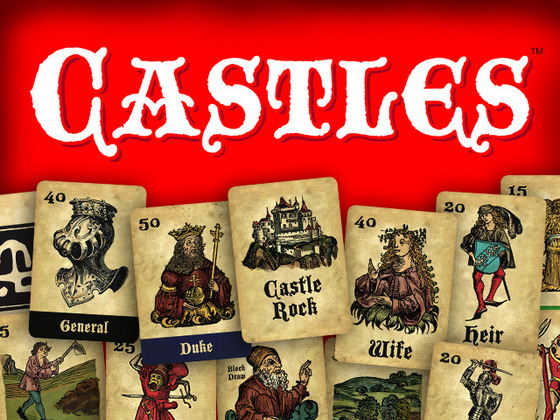
CastlesCastles—A Strategic Card Game for Two Players—AAIIEEE! Games

The first release of AAIIEEE! Games, Castles boasts being a quick, unique card game that will have two players battling it out using wizards, minions, and more. This one has us intrigued, and they should be able to hit their funding goal of $6,000.

The campaign ends Nov. 9, and it's only $20 for the game—you can find the full campaign here!


NovusNovus Feature Card Game—Zenion Game, Inc.

Zenion is calling Novus a "Feature Card game" which is a CCG without the "Collectible." This game comes with 4, 50-card decks. To play, pick a deck, shuffle, and go. This one looks like a Kickstarter no-brainer: cool theme, great art, great concept. They've already unlocked 3 stretch goals and there's plenty of time for more!

The campaign runs until Nov. 1 and $32 gets you a copy of the game—you can check out the full campaign right here!

Thanks so much for reading! You can also find us on Facebook, Twitter, YouTube, and Instagram, and you can download our Podcast on iTunes!

So, what are you backing on Kickstarter? Let us know!

Bottom Banner

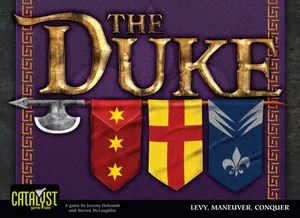
The Duke—A Double-Take Review—Plus a Video Review!

The Duke—A Double-Take Review—Plus a Video Review!

There have been some famous Dukes over the years. First we've got John Wayne—an iconic and larger-than-life figure. Then we have the Dukes of Hazzard. I can't overstate the influence that show had on me as a kid—there's nothing I looked forward to more during the week than Friday night with The Dukes. Now there's a new Duke on the scene—a board game from Catalyst Game Labs. Can it possibly live up to history's Dukes? Let's find out!

Read More

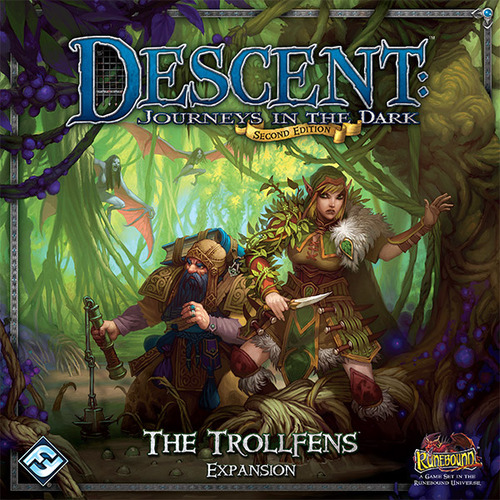
Fantasy Flight Releases the Trollfens Expansion for Descent 2.0

Trollfens By Firestone

Fantasy Flight has released another "small" expansion for its hit dungeon-crawler, RPG, board game Descent—this time you'll be taking a trip to the dangerous Trollfens...

The game comes with two new Heroes—Roganna the Shade, and Augur Grisom— and two new Classes—the Stalker and the Healer.

For monsters, you'll see Plague Worms, Harpies, and Bol'Goreth, a huge troll who will get his own miniature in an upcoming Lieutenant Pack.

There are also five new quests that you can add to your campaign, or play as one-offs. Finally, there are some new terrain tiles that add a swampy terrain that can hold both treasures and dangers.

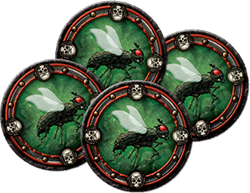
infectiontokensChime in! Have you played Descent? Are you excited for this? Is Fantasy Flight coming out with too many expansions too quickly?

Rudiger Dorn is 'Walking' Back With a New Design!

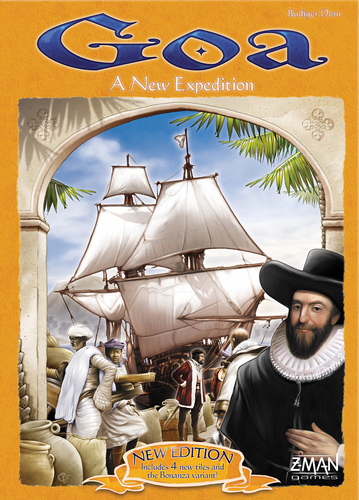
GoaBy Firestone On my very first game night, almost 10 years ago, I played a game called Goa, designed by Rudiger Dorn. It was complex and confusing and I'd never played anything like it. I instantly fell in love. So I have a soft spot for Dorn and his games, and the announcement of a new game—Istanbul—fills me with joy.

Part of the reason is that I just like getting new meaty games from some of the classic designers (Dorn, Wolfgang Kramer, Reiner Knizia), but also because this game looks to use Dorn's "walking" mechanism.

Here's the description from Boardgamegeek.

"In Istanbul, you lead a group of one merchant and four assistants through 16 locations in the bazaar. At each such location, you can carry out a specific action. The challenge, though, is that to take an action, you must move your merchant and an assistant there, then leave the assistant behind (to handle all the details while you focus on larger matters). If you want to use that assistant again later, your merchant must return to that location to pick him up. Thus, you must plan ahead carefully to avoid being left with no assistants and thus unable to do anything...

Prototype image: NOT final.

In more detail, on a turn you move your merchant and his retinue of assistants one or two steps through the bazaar, either leave an assistant at that location or collect an assistant left earlier, then perform the action. If you meet other merchants or certain individuals at the location, you might be able to take a small extra action. Possible actions include:

  • Paying to increase the your wheelbarrow capacity, which starts the game with a capacity of only two for each good.
  • Filling your wheelbarrow with a specified good to its limit.
  • Acquiring a special ability, and the earlier you come, the easier they are to collect.
  • Buying diamonds or trading goods for diamonds.
  • Selling special combinations of goods to make the money you need to do everything else.

When a merchant has collected five diamonds in his wheelbarrow, players complete that round, then the game ends. If this player is the only one who's reached this goal, he wins immediately; otherwise ties are broken by money in hand."

Dorn has used this mechanism, of leaving pieces behind in order to move, to great effect in other games—Genoa, Louis XIV, and Goa all use this, and they're all terrific games. So Dorn returning to put a new spin on this is exciting news. And in the meantime, if you get a chance to play Genoa, Louis XIV, or Goa, YOU SHOULD DO IT. You'll be glad you did. In the meantime, keep an eye out for Constantinople Istanbul.

Thanks for reading! Have you played any Dorn games? What was your impression? Share your thoughts!

Pixel Lincoln—A Double-Take Review—Plus A Video Review!

pixelcover"Four score and seven years ago, I kicked some serious butt with a sausage link whip...." ~Abraham Lincoln  Deck-builders and retro 8-bit graphics—two big gaming trends that have been smooshed together in Pixel Lincoln. What did we think of it? Keep reading and find out!

The Basics

Pixel Lincoln is a side-scrolling deck-building game designed by Jason Tagmire. It's for 1-4 players, and takes between 30 and 60 minutes to play, depending on the number of players. The goal is to score the most VPs.

LincolnBox

4 player tableaus

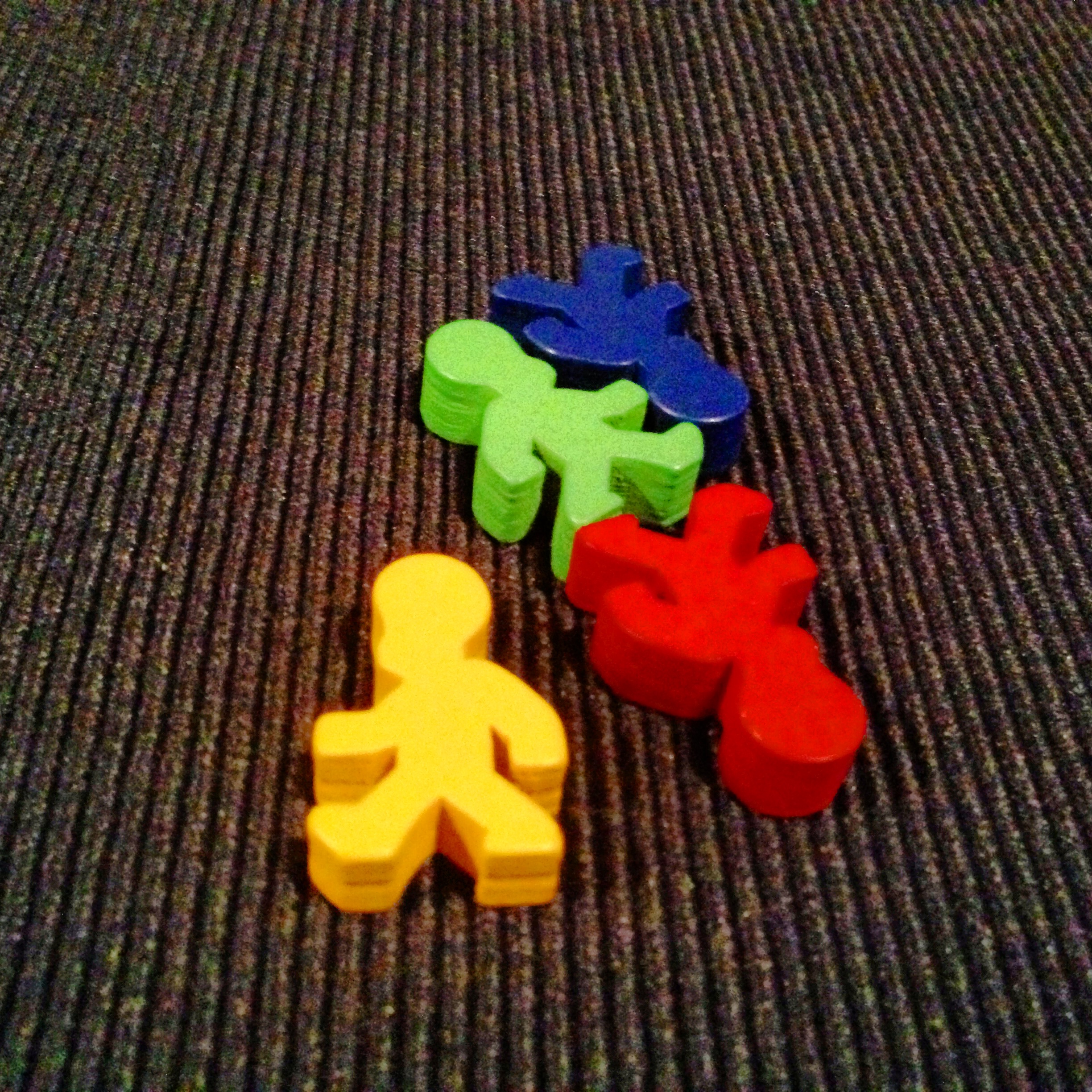
4 wooden Lincoln meeples

Cards—including Characters, Enemies, Items, and Player cards.

Double-sided player board

A HUGE sturdy box

The Setup

As with most deck-builders, you start with a starting deck of cards—5 Beardarangs, which give you one Power, 5 Jumps, which also give you one Coin. You set the board out to whichever side you'd like (there's no functional difference; it's just different scenes depicted on each side). You also have one Player card and two Life cards that you place on your tableau.

Then you create the two Level Decks. You combine three Enemies, three Items, three Characters, and a Special Item. You shuffle that all up, divide the deck into three small decks, shuffle three Checkpoint cards into each of them, and then stack the three decks on top of each other.

Finally, you set a facedown Mini Boss and Boss card off to the side for each of the two decks.

The Gameplay

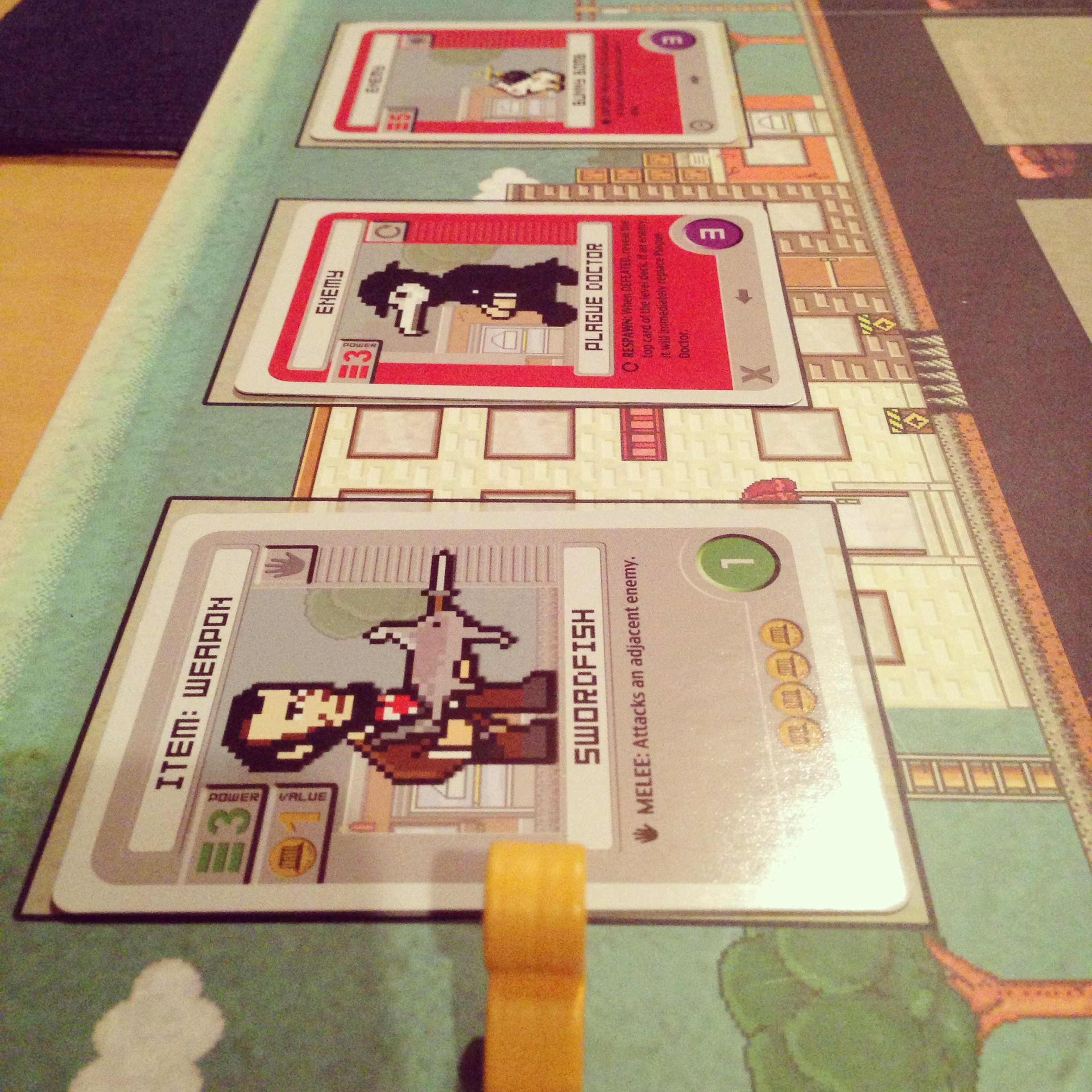
On a player's first turn, he or she chooses a Level to engage. So you take your Lincolneeple and put him in front of one of the Levels and start to make your way through it—just like an old-school side-scroller. There's no restriction on how many people can be in one Level—though there are certainly strategic reasons to pick one over the other.

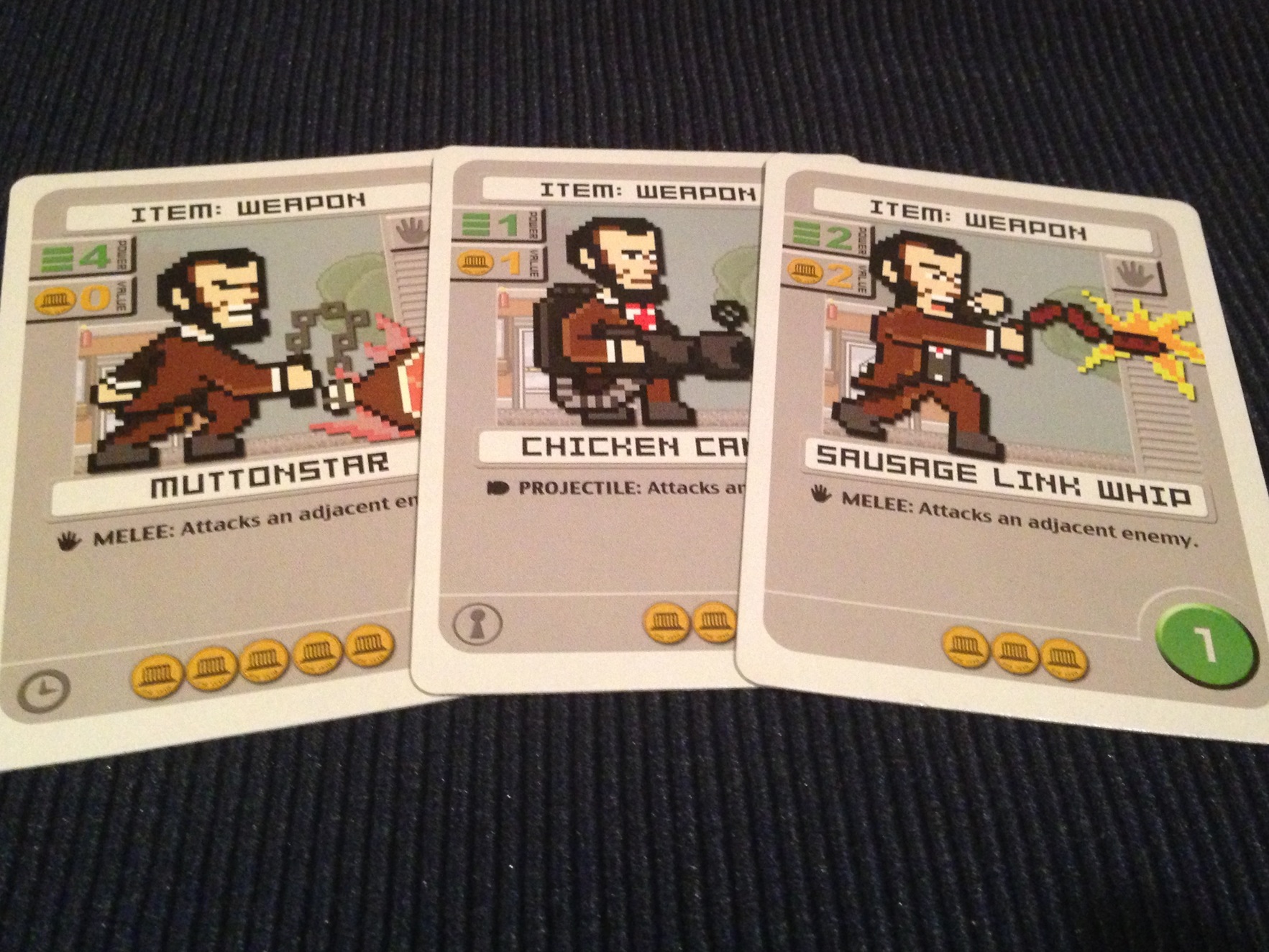
LincolnCardsYou have five of your initial 10 cards in your hand. Beardarangs (and later weapons you purchase) let you fight the Enemies. If you meet or beat their toughness, you defeat them and you place the card in your scoring pile on the tableau. Unlike many deck-builders, cards you defeat don't go into your hand to clog it up.

Jump cards let you Jump one card in front of you—maybe you can't fight an Enemy, or don't want an Item, so you just pass it. You can also use the Coin on the card to buy the Item in front of you. If you do, it's added to your discard pile, like a normal deck-builder. If you start your turn in front of an Enemy, it 'ambushes" you, so you have to deal with it in some way—either defeating it or Jumping over it.

LincolnEnemiesIf you can't defeat or jump over an enemy when it ambushes you, it hits you, and you remove one Life card. You start with two of them, and your Player card is your third one. If you lose all of your lives, you're eliminated, and wait until the game is over, or everyone else dies, to add up VPs. Life cards are worth 5 VPs at the end of the game, so you want to stay healthy!

Most cards in the game have a small symbol in the bottom corner—an X or a Key or a Clock and so on. Character cards task you with collecting certain symbols by the end of the game, and if you do, you'll get VPs. The Character cards also cost you to buy, but they go to your score rather than your discard pile. Speaking of those symbols, if you discard a card with a symbol on it during your turn, you get to either score a card from your hand, look at and rearrange the top cards of the Level Deck, exit the current level and enter the other, or cancel the effect of an Enemy or Item card—either on your turn or on an opponent's turn to keep them from doing something cool.

If your Lincolneeple gets through the current "screen" and makes it to the Level Deck, everything behind him is wiped away, he moves back to the front of the Level, and you draw five new cards—so it's like a side-scroller, in that anything you pass is gone and you can't go back and get it again.

There are three Checkpoint cards in each Level Deck. The first time someone hits the Checkpoint everyone in that level gets to do one special action: either exit the level, draw a card, or put a card from your hand into your scoring pile (basically culling a card). The person who actually reaches the Checkpoint gets to do one of those things twice.

The second time you reach a Checkpoint, you still get to do one of those things, but now you place the Mini Boss card where the Checkpoint card was. Mini Bosses are just that: stronger than regular Enemies, but not as strong as Bosses. They're worth VPs, depending on which Mini Boss it is. They can't be jumped over or bypassed—you have to defeat them to continue in the level. When you reach the third Checkpoint card, you get the bonus, and then replace it with the Boss card. It's tougher, and worth more VPs.

Once both Bosses from both Levels have been defeated, the game is over, and you count up VPs.

LincolneeplesThe Verdict

Firestone—First of all, I really love the artwork in the game. I vividly remember the Christmas I got my NES—I spent the WHOLE day playing Super Mario Brothers. It was the start something big and influential in my life. The artwork definitely takes me back to that, and is fun.

Jeremiah— Yep! The artwork is amazing; I remember when I saved up a bunch of money and my parents drove me to Gold Circle and I bought an NES, which came with Super Mario Bros. and I bought a copy of Kung Fu. So legit...

Firestone—The theme is fun, and way more interesting than Dominion. Zzzzz... So getting my kids, or teenagers, or whomever to play this will be easier. Probably. Because let's face it: My kids don't care about retro, 8-bit graphics. In fact, to their eyes, they look junky and old. But still, the theme is is unique

Jeremiah— The theme is what drew me into the game. It's wacky and out there, but lots of fun. Dominion is a great game, but you'll never find a mutton-star in your Dominion deck, nor will you have to face down a Puking Turtle.

Firestone—The components are hit-and-miss for me. If there's one iconic aspect of Abraham Lincoln, it's his stovepipe hat. Unfortunately, the Lincolneeples look like they're wearing Afros, rather than stovepipe hats. The cards are fine, but kind of thin. The tableaus are nice, thick cardboard, with a good finish on them—though I did find it weird that there's no place for your deck or discards. I really like the Level Deck boxes that come with the game. Setup is time-consuming (as with most deck-builders), but you can create the Level Deck ahead of time and put them into these nifty boxes, which look like old school NES boxes.

Jeremiah— I think the one component that fell shortest to me, is the meeples, Lincoln meeples would have been awesome; these are just weird looking meeples. I agree that the player boards are laid out oddly, but for the most part I'm good with all the components. In fact, the level board is great, a friend of mine always says that card games need boards—well, in this game, you've got them!

Editor's Note: Jason emailed us to let us know that the reason he doesn't have a hat is that Booth stole it, which started this whole affair! So we just missed that, and are dorks. Sorry, Jason!

LincolnLayoutFirestone—The weird thing to me is that when I play a game that calls itself a deck-builder, I expect to...build my deck. You're kinda doing that here, but there's nothing to clog up your deck, so defeating enemies is a no-brainer. And there are few opportunities to cull you deck. You can do it three times if you are in the Level when someone hits the Checkpoint, and if you choose that as your bonus, and if you have something you want to cull in your hand at that time. That's a lot of ifs. You can also discard the cards with the star "suit," but again, that's only if you've picked up that card during the game at some point, and if when you draw it again, you have one in your hand that you want to cull. So it's less a deck-builder and more a deck-adder. Kind of. At any rate, I still felt that I had super-clogged-up hands at the end.

Jeremiah— Yeah, it's more of an 8-bit adventure simulation game, and in my opinion it does that creatively and well; "deck builder" is sort of a misnomer with this one, but I don't mind it at all, because I think the game itself—which has deck building elements to it—is fun and a nice trip down memory lane. I've thought more about the not being able to cull cards as often aspect of it, and it makes a little more sense to me, seeing as how half of the cards in the level don't go into your deck, they get scored, if you could cull cards often you'd not have much of a deck left... Just an observation.

Firestone—This also seems to have a player-number problem. When I played with four, there's so little control that it's easy to find yourself in front of an enemy (or worse, a Mini Boss or Boss) at the start of your turn. Hope you can deal with it. One guy got seven turns during the game: four turns of doing something, two turns where he couldn't do anything—anything, and one turn of being able to do nothing but his hit by a Mini Boss he'd started his turn next to. On those four turns where he did something, he bought two one-coin-cost cards for his deck, and those were the only Item cards he ever had the opportunity to buy. That's a problem.

Jeremiah and I played a 2-player game, and there was much more control, and it just "felt" better.

Jeremiah— When we played with 4 players we didn't run into the issues you described, but I could see the game changing, especially in the later stages of it, as players are burning through cards in the level before your turn gets back. I'm guessing 2-3 might be the sweet spot to keep it balanced.

Firestone Final Thoughts—I'm really not happy about becoming the Grumpy Old Man of the blog, but this game just didn't do it for me—at all. It's thematic and has fun enemies and items, but it's mechanically mediocre. If I didn't already have the DC Comics Deckbuilding Game, I could see using Pixel Lincoln to introduce my kids (or nongamers) to deck-builders. But I do have it, and it's just better, so I'm going to use that. Maybe I'm taking it too seriously. And I'm sure there are groups out there who will LOVE the art and theme and humor, and this game is just perfect for them. But my group and I didn't like it, so for me, Keep This on the Shelf

Jeremiah Final Thoughts—Yep, I disagree. If you go into this one expecting a deep deck-building experience, you will likely be let down. However that doesn't make the game any less fun; it's just a different type of fun. Let's have some real talk for a second. You're a pixelated version of our 16th president, who is going through levels of a game fighting absurd enemies, using -possibly- even more absurd weaponry to defeat "bosses." I'm pretty sure you might be taking this one too seriously if you take it seriously at all. This is a fun, light-hearted game that will amuse the younger crowd, and delight those old enough to appreciate the nostalgia. Grab your Chicken Cannon, strap on your Beardarang, and Put This on Your Table!

We'd like to thank Game Salute and Island Officials for providing review copies of Pixel Lincoln. This in no way affected our opinions of the game.
Thanks for joining us for the review! And check out the video review down below!!

[youtube http://www.youtube.com/watch?v=50rXovc3fWc]

photo-332.jpg

Kickstarter Weekly—Oct. 9, 2013

Hey gang! We apologize that we haven't been bringing our usual steady flow of content the past 10 days or so, but life has been a little topsy-turvy for us—but we're getting our ducks back in their rows. In the meantime here's a look at some projects over on Kickstarter we think you should take a look at!

Featured Campaign!

Star RealmsStar Realms - Robert Dougherty

Star Realms is a pet project of Rob Dougherty and Darwin Kastle, two highly acclaimed MTG tournament winners. Star Realms is a 2-player deck-builder that is expandable to multi-player just by adding another deck for each 2 players who want to join the game. Unlike most deck-builders this one is a head-to-head combat style of game: less purchasing of Duchies, and more slugging it out.
It's way easy to get into at $15 for one deck (2-player version) but for an extra $10 you get a bunch of cool promos and freebies thrown at you! You can check out the full campaign, right here, and you have until Nov. 2 to get in on this one!


Castle RisingCastle Rising - Lost Games Entertainment

A very slick-looking strategic and economic board game. Players will seek to create the most prosperous kingdom, by building structures, training units, and gathering resources. The funding goal is pretty low on this one and they're already over half way there!
It's a little pricey to get in on this one if you're in the US because they're shipping from the UK; a pledge of $66 USD gets you the game, and you have until Oct. 26 to check out the campaign here.

PandantePandante - David Sirlin

Gambling - Lying - Pandas. In this amalgamation of poker and liar's dice, players play a poker-type game in which everyone lies about their hand. If no one calls them out on it, their hand is what they say it is.

A pledge of $35 gets you the basic version, and there is a deluxe version that runs $250! The campaign ends Nov. 7, and you can check it out here.


Sneak Preview!

Monsters and MaidensMonsters & Maidens - Clever Mojo Games

In a game for players 8 and up, this dice-rolling press-your-luck game looks like dicey fun for the family!

A pledge of $15 will score you a copy of the game, and the campaign (although not yet live) can be found right here!


Thanks as always for reading! We hope to hear from you out there on the internets - Facebook, Twitter, Instagram, YouTube and our Podcast!

Are you backing any of these games? Are there any out there we're missing out on!?

Bottom Banner