Fluxx On Your iPhone!

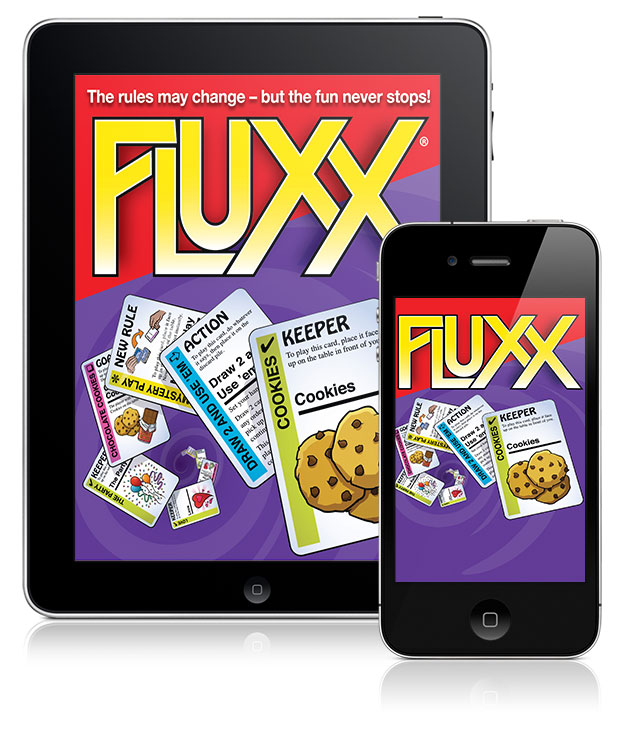
This just in: Looney Labs has announced that a mobile version of their hit card game Fluxx will be available on the iOS platform. The mobile version will feature local play (Pass and Play) as well as solo mode vs. AI, and asynchronous support for online multi-player support. Looney Labs has hinted at a streamlined experience, with most likely fewer rules in the "deck." It appears that the game will be the original version of the game and not one of the themed decks. You can read our full review of the original Fluxx right here. You can check out the official news from Looney Labs about the iOS version right here.


Hail to the Chief! An interview with Pixel Lincoln and Jason Tagmire

It is with great pleasure, and an extreme sense of patriotic pride, that we bring you this week's interview, with not only Jason Tagmire, designer of the Kickstarter smash hit "Pixel Lincoln," but today he's brought along his close personal friend the pixelated President himself, Pixel Lincoln!

Jason, Mr. President, thanks for taking a few minutes to answer some questions for us today. Jason, could you explain a little bit about how you approached the President about creating a card game based on his adventurous life?

JT: I didn’t at first. I saw his shiny face on a penny and decided to use it as a token in a prototype. Eventually that penny became the main character, and I had no other choice. I made a few phone calls, pulled a few strings, and the rest is history.

Mr. President, tell us about your first meeting with Jason.

PL: He came into my office with a prototype of his game, Pixel Lincoln. Now, this was not the deckbuilding game that we all know about. This was a terrible little card game where you roll a die and move a penny around the cards. I told him to give it another shot and we would talk about it.

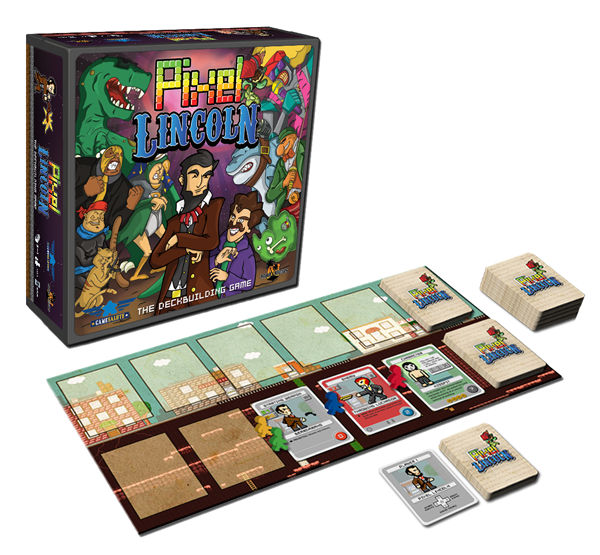
Jason, so Pixel Lincoln is a deck-building, side-scrolling card game; how does that work? And what’s different about this deck-builder than the others out there?

JT: It’s deck-building in that all players start out with the same basic cards in their deck, and throughout the game the players will obtain new cards, making a better and better deck.

It’s side-scrolling in that you have a meeple that moves throughout the cards that are available, simulating a side-scrolling video game.

And it’s different in that it takes a very different approach to the style of game, and will probably be compared to Megaman before it’s compared to a game like Dominion or Ascension. I designed it to first and foremost feel like a video game. The cards that are available for purchase are only available for a certain amount of time before the screen scrolls, or they are purchased/defeated by other players. There are checkpoints and boss battles that come in after so much time passes. Players can switch between levels for a different experience, with completely different cards available.

Mr. President, can I call you Link? Nevermind... Did you sign off on the game, and if so, how historically accurate did you find the game play experience?

PL: The game is 100% accurate. This was the story of my life that I always wanted people to know, but the government is pretty good at covering things up. I signed off without hesitation, and I can’t wait for the truth to get out there.

Jason, you’ve been creating games for about 5 years now, which of your previous releases still holds a warm spot in your heart?

JT: Famous Missions. It’s a game where one player provides a mission (“Dismantle A Bomb”) and the other players choose their 3 best celebrities to complete that mission. Some celebrities may be helpful in these scenarios (Chuck Norris, Albert Einstein, Mr. T.) and others less so (Paris Hilton, Donald Trump, Carrot Top). After players choose their teams of three, they get to argue on their behalf, and the judging player chooses the best team for the job.

The game is always a good time, especially with a creative group. After a few years of self-publishing it, I listed it on Kickstarter in Sept 2011 and it failed miserably. There are a few reasons why, and I’ve learned so much since then, that it turned into a very positive experience for me. But as for Famous Missions, I’m not going to give up on it. It’s too much fun to forget about. Plus it was my second game with my good friend Lincoln in it.

Mr. President, do Mary and the boys know about the game? What do they think of your pixelated adventures? I bet the boys think it’s cool that you’re also going to be the star of a video game too!

PL: Shhhhhh. I haven’t told Mary yet. She is not a big fan of the video games. But the boys are very excited about it. Although you can’t get their hands off of Borderlands 2, they do love the classics. Battletoads is a big hit in our house. That level 3 is impossible!

Jason, speaking of the video game version: What format will it be available on? Am I going to have to break out my old NES system for it? (Because I will!)

JT: It was originally being developed for DS, which was as close to NES as we could get, but we’ve switched over to Steam. It will initially be PC and hopefully Mac will follow, because I do not have a PC and I want to play! If it’s successful, we can make the transition from Steam to PS3/Xbox 360 to 3DS.

This question is for both of you. What are your top 3 games right now?

JT:

Alien Frontiers Cosmic Encounter Battle Beyond Space

I guess I’m going through a space phase right now.

PL: Food Fight Junta: Viva El Presidente Chrononauts

Jason, outside of designing games what inspires you to “carpe diem”?

Definitely my family. My wife and I have a 4 year old daughter, and 2 year old twins, and they are all crazy. We’ll play and make games together, but more often we’ll just take off and see where we end up. It’s not unusual for us to drive 3 states away just to go to some silly little burger stand.

The next set of questions only requires a one word (or phrase) response!

Jason -

Favorite time travel movie? 12 Monkeys

Favorite snow creature: Wampa or Bumble? Wampa

Who wins in a fight: Iron Man or Hulk? HULK SMASH!

Best sandwich EVER? The Primanti Brothers in Pittsburgh.

Favorite A-Team member? It’s hard to top Mr. T, but I do love B.A. Baracus.

Mr. President -

Favorite non-confederate state? New Jersey

Favorite Gilligan’s Island castaway? Thurston Howell III

Favorite vampire slayer? Simon Belmont

Favorite campaign slogan? Where’s The Beef?

Captain Kirk or Captain Picard? Captain Kirk

Thanks again for taking time to answer our questions! If you want to check out Pixel Lincoln the game you can visit their Web site right here! And while you're there you can pre-order your copy of Pixel Lincoln, which is due for release this year! Thanks again for reading!

Great Big Table - Extra Life Interview

Today we're giving you a bonus interview—this time with Adrienne Jones—about the Extra Life gaming marathon that benefits Children's Miracle Network hospitals.

Thanks for contacting us about this great benefit.

First take a minute and tell our readers what Great Big Table is all about.

Great Big Table is a board games podcast that focuses on the community side of board gaming. With social media input from listeners, we like to talk about topics such as finding or creating a game group, game elements that work well for specific audiences (kids, couples, non-gamers), building a game collection, and ways game groups can influence their larger communities.

Can you tell us a little more about the Extra Life organization? Is this your first year participating in this event?

Extra Life began in 2008 when the Sarastic Gamer video gaming community worked to honor Victoria Enmon, a high school sophomore with acute lymphoblastic leukemia. In her memory, 1600 participants played 24 hours of games and raised $115,000 for Texas Children’s Cancer Center in 2008. In 2009, in an effort to help children’s hospitals worldwide, organizer Jeromy Adams left his radio broadcasting career to work for Children’s Miracle Network Hospitals. With this change, in 2010, donors were able to raise money for any Children’s Miracle Network Hospital. And they did, raising over $451,000 (more than doubling their 2009 donations).

Last year, Extra Life was played simultaneously on every continent but Antarctica, and raised $1.1 million for 175 children’s hospitals.

On the whole, Extra Life has been a video gaming movement, but that has been changing. Joining in 2010, Myriad Games, brick and mortar board game retailers in New Hampshire, were some of the earliest board gamers to champion the cause. Their podcast, Myriad Games Presentations, helped bring the cause to the attention of other board game podcasters as well as the larger board gaming community.

Organizer Jeromy Adams is happy to see the event spread to new communities and has been particularly interested in how it can translate to board gaming which is an inherently social activity.

Tell us your story, and why this event is so special to you.

Our inspiration to be part of Extra Life is an almost 2 year old dynamo who is presently wearing penguin jammies and sitting in my lap.

Our daughter’s life is inextricably tangled up in board gaming and Riley Hospital for Children, Indiana’s Children’s Miracle Network hospital.

Back in 2010, I was seven months pregnant and looking forward to a great gaming weekend with friends to celebrate Jim’s birthday. The pregnancy had been tough and we normally hosted game night, so our regular gaming with friends had been on hiatus for months.

Two weeks before the game marathon, and six weeks before the baby’s due date, my body started shutting down. With two of my organ systems failing, our baby girl was rushed into this world.

From her first day of life, a specialist from Riley assessed and cared for her even though we live four hours away from the hospital.

We were all very fortunate, and she was released from the NICU well before her original due date. Friends and family rallied to help us keep up with the basic needs of our older kids while adjusting to her additional feeding needs.  Jim’s coworkers sent us a care package and in the card many of them mentioned that they had missed him at the staff Christmas party where he usually ran the games.

Because of those comments, I suggested that Jim organize a weekly game group at work. He sent out an email, mostly to appease me, but people responded. Now, on Wednesdays, you can usually find a group gathering near the snack machines at his workplace to fight worldwide epidemic disease, build fiefdoms, race sled dogs, or manipulate the stock market in Jane Austen’s England.

Home life wasn’t entirely normal, but gaming made it more familiar and gave us non-medical things to talk about. When the baby reached 10 months, problems with her growth and development appeared. The baby and I headed to Riley Hospital in Indianapolis for tests and answers.

It’s pretty overwhelming to realize that your child has medical needs that are larger than average. It’s hard to stay in a hospital room hours from home. Yet Riley’s very architecture resonates with the goodwill of friends and strangers. There I saw such unconditional generosity toward all children. It seemed as if the entire state was rallying behind these kids and their families as they faced individual health challenges.

We got her growth back on track that week, but we also learned that she would need cranial reconstruction surgery.  Around this time, we started a monthly game night at our church in addition to the weekly game group Jim had been running at work.  It seemed like a service we could offer to a community in economic downturn.  We definitely realized the value of getting away from difficult everyday concerns.

In February, during her 8 hour surgery, we played Lost Cities to keep from losing our minds between updates about the surgery’s progress.  Again, we were overwhelmed with the community spirit of Riley.  Our daughter ended up needing 2 units of blood (total replacement for her body weight), so even the blood in her veins was a gift from strangers.  Being given something so basic and life-sustaining impacted us all deeply.  We wanted to give back.

In 2011 Jim had heard a Game On! with John & Cody podcast episode about participating in Myriad Games’ Extra Life event.  Though I had no idea even during the surgery, Jim was already making plans for an Extra Life event at our church.

Our local community (including those great work and church gaming groups) welcomed us back home with more than enough meals for a month.  Before we’d eaten even half of the meals, Jim had laid the groundwork for this event.

We really view this as the building year for an annual event.  Because our group has many families with young children involved, a continuous 24 hour marathon seemed impossible.  Jim adapted it to be a three day event launching with our regular monthly game night.

How many people are on your team?

Technically, one at this point. Jim set up the team for the church’s game group, so I’m (presently) the captain and only member of Team Great Big Table. St. Peter’s Game Night Team is a partner to Great Big Table, so our number of registered participants is six when you include them both.

We have heard from many online friends, like Chris Norwood of GamerChris.com, mention that they are starting their own teams or joining a local event.  From our standpoint, that’s even better than joining our team because a local focus may help people gain more momentum.  We’re just happy people are joining and participating in the event.

But should anyone want to join a team, there’s always room for more folks at Great Big Table. Actually, that’s even where the podcast name comes from, the idea that we always have room for another chair at our gaming table.

The weekend event will also involve donors as well as registered players.  We’ve set aside some hours for kids’ games and some for classic card games, and we know that people will come play and will make donations at the event.  For those who don’t want to donate online, the church is accepting cash and checks and issuing receipts so in-person donations can also be tax deductible (like the online giving).  With our community, online giving may not be as appealing as in-person donations, so we wanted to offer ample opportunity to give.

What game(s) will team Great Big Table be playing during the marathon, and why?

As with our game nights, the community will share many of the games.  We have a church games library of about 30 donated games ranging from Bananagrams to Liar’s Dice to Risk to Tsuro.

Favorite games that regularly make a game night appearances are Lords of Waterdeep, Kill Dr. Lucky, Eleminis, Carnival, Hike, Can’t Stop, Alien Frontiers, Sorry Sliders, Zooloretto, Word on the Street, Dixit, Wits & Wagers, Forbidden Island, Apples to Apples, Castle Panic, and the Resistance.

Our family game closet has a lot of Euro, strategy, cooperative, kids’ and party games, and I think there is a similar composition to the game night selection.

Because we really want a lot of people playing during the event (to keep the registered participants company), we’re sure to have traditional card favorites like Clabber (a local card game similar to Euchre) and cribbage and plenty of kids’ and party games.

We hope that anyone will be able to find a game that interests them when they visit.

Thanks for sharing your story with us, and best of luck in reaching your goal!

The event is October 20th. For more information, check out the Web site here. And if you'd like to support team Great Big Table, you can find their team page here. Thanks for reading!
We Review Spot It!

By Firestone When it comes to board games, if there’s one question I’m asked more than any other, it’s “Where do you get these games?” Usually I have to tell people that they can get it on Amazon (if they’re lucky), and on online retailer or game store if they’re not lucky. That’s why it’s great when I can tell people that a fun game is available at their local Target store.

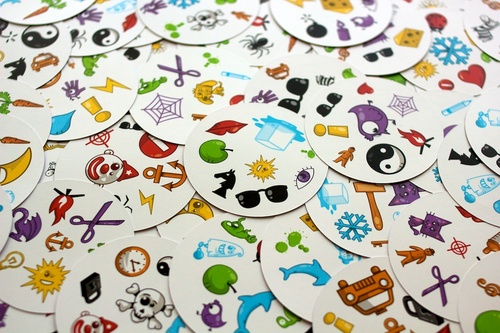
Spot It! comes in a round tin, and it’s just 55 cards with symbols on them. Each card has 8 different symbols on them—from a larger pool of more than 50 symbols. In the basic game, you’ll flip over two cards, and whoever can first spot the lone symbol they each share has to call it out, and then that person gets the card. What’s hard is that the symbols aren’t just different from card to card, but they vary in size, too. A ladybug might be gigantic on this card, and tiny on that one.

The game comes with many ways to play—but they’re all versions of be-the-first-to-spot-the-matching-symbols. Our favorite is called The Tower. Each player gets one facedown card; the rest of the deck is placed in a faceup pile in the middle of the table. At the same time, each person turns his or her card over, and then everyone has to find and call out the symbol their card and the center card has in common. Each person will have a different symbol that matches the middle one. If you win, you get the card and add it to the top of your pile. That will reveal a new card from The Tower, and you look for a new matching symbol. When The Tower is gone, you count up cards, and whoever has the most cards wins.

It plays from 2 – 8 players, the rules are super simple, and it’s really portable, so this would be a great game to play with a group of teenagers. Or your family.

So the next time you’re at Target, consider Spot It! It’s fast, fun, and cheap, and portable. What more could you want?! Thanks for reading!

Trace Amount - New Netrunner Data Pack Announced

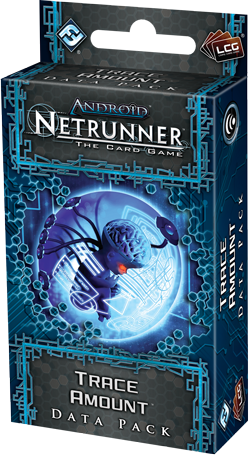
The folks over at Fantasy Flight Games have announced the second data pack expansion for their newest Living Card Game, the re-imagined Netrunner. Trace Amount is the second data pack of the Genesis cycle, and features 60 cards (3 copies of 20 different cards). As with any of Fantasy Flight's LCG's these expansions add more depth, and more strategic options for players and add to the replay value of the game, without chasing cards down by buying box after box of boosters. (And how creepy weird is that baby on the cover?!)

For more info on Trace Amount, and some nifty card previews Click Here!

Also, our Kickstarted copies of Resistance: Avalon are in the mail, so we'll have a review up as soon as possible!

What You Missed

If you haven't been around this week, you've missed out on some fine blog posts here at TOG! Let's take a quick look back, as we move into the weekend! The News on Monday: Z-Man Games is releasing an English version of Robinson Crusoe, a co-op game of island survival!

The Review on Tuesday: Firestone reviewed Donald X. Vaccarino's Gauntlet of Fools.

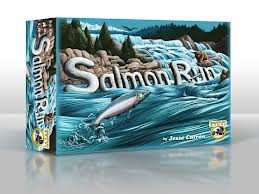
The Interview on Wednesday: This week's interview featured Jesse Catron as he discussed his new Kickstarter campaign, Salmon Run, a racing, deck-builder with a fishy theme.

Kickstarter Weekly on Thursday: We featured the campaign of the converse version of Castle Panic! Known as Storm the Castle!

Also Today, we've added another little page to our humble site titled "Get Your Game Reviewed", enjoy!

Stay tuned next week, or else you'll miss more news, reviews, and interviews, including a very special, presidential interview with a very special guest, don't miss it!

Thanks again for reading, and have a great weekend everyone!

Storm the Castle! - Kickstarter Weekly

Somewhere in the Bizzaro Universe while Castle Panic! was being developed, Storm the Castle came into existence, and made its way to our reality--well, at least it will if Giant Goblin Games has its way. Storm the Castle is a 1-4 player semi co-op battle game where, unlike Castle Panic!, players are joining forces to lay siege and conquer the castle. Over on Kickstarter there's still plenty of time to jump in on the campaign, and there are a TON of stretch goals waiting for you (all the way up to $100k).

The game looks interesting and the concept sounds really fun! The premise of "being the bad guy" is always an interesting twist on your gaming experience. Giant Goblin is promoting this as a kid/family friendly game, although to be honest, I'm not sure I'd be cool with my 6-year-old taking control of the "Undead Horde."

The Kickstarter Campaign looks like it will be funded, so jumping in now is just one step closer to the next stretch goal! Head on over and check out their campaign, and we'll see you next week with another Kickstarter Weekly!

We Interview Jesse Catron—Designer of Salmon Run

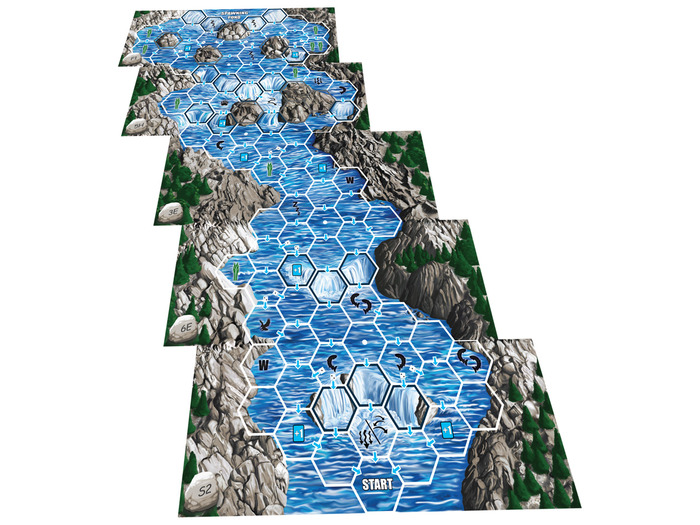
Thanks for agreeing to answer some questions. Can you tell us a little about yourself?  Sure, I’m 35 years old and I live in Maryland with my wonderful wife and our 6 dogs.  I‘m an Optometrist by profession; my hobby is board gaming, and my passion is board game design. Your new game Salmon Run is a combination race game and deck-building game. What gave you the idea to combine those two types of games? Salmon Run was very much a theme-first design. The theme led me to develop it as a racing game.  The salmon would race each other upriver to spawn. The long and grueling nature of the salmon's journey upriver led me to develop the fatigue mechanic. Being more of a marathon than a sprint, I wanted to emulate the struggle the salmon endure and reward pacing. Having fatigue cards accumulate in each player's deck to slow them down by the end of the race seemed natural.  Having “rest” areas where players could remove fatigue also seemed logical. Since the movement (swim) deck was dynamic and changed over the course of the race, I layered in the other special cards that could be added along the way. This greatly enhanced the experience, allowing for more deck specialization and more player interaction.

What’s your favorite race game, and why? Not including my own, I have always been fond of Wolfgang Kramer’s racing system which includes Daytona 500, Top Race, Detroit-Cleveland Grand Prix. I really enjoy its simplicity and accessibility, its pre-race auction, and its card-driven movement. The dichotomy of controlling both your car(s) and your opponents is fascinating and makes for some interesting decisions and some light diplomacy.

What’s your favorite deck-building game, and why? I must preface my response by saying there are many DBGs I have yet to play, so my experience is limited. That being said, I will have to stay with the original: Dominion. Often imitated and enhanced, the simplicity and genius of the design still shines through. It's fast and accessible, with multiple strategies and great replayability.

How did you first discover Euro board games? I grew up playing a lot of board games like Risk, Monopoly, Axis and Allies, and the original Survive! Later on I got into collectible card games like Star Wars and the Star Trek CCG. Games were always an interest of mine and I never really stopped playing them. One year my brother bought me the Settlers of Catan for Christmas. Perhaps it was its dry theme but it sat on my self for about a year while I continued stupidly pouring money into CCGs. Eventually I played it and became hooked, and began to expand into other euro games.  Though it's not perfect, Settlers remains the game I've played the most and I still very much enjoy playing it when I can.

Who is your favorite game designer, and which of that designer’s games is your favorite? This is a very tough question to answer!  There are many designers that I respect and admire, and the reality is I have yet to play enough of their games to form a valid opinion. A few that come to mind are Wolfgang Kramer, Michael Schacht, Antoine Bauza, and Stefan Feld. However, at this time, my favorite is Martin Wallace. I enjoy his unforgiving economic mechanics and historical themes. I admire his innovative use of deck-building in a war game in A Few Acres of Snow (despite its flaws). My favorite game of his is Steam. Steam melds many mechanics together in a very smooth and refined package while keeping in track with its theme. 

One-word Response Questions:

Creamy or crunchy? Crunchy

Burger topping? BBQ-sauce

Favorite musician/band? (This can be more than one word, as necessary.) The Beatles

Trek or Wars? Wars

Batman or Superman? Batman

Thanks to Jesse for taking the time to answer our questions. Now go check out his Kickstarter campaign, Salmon Run! And as always, thanks for reading.

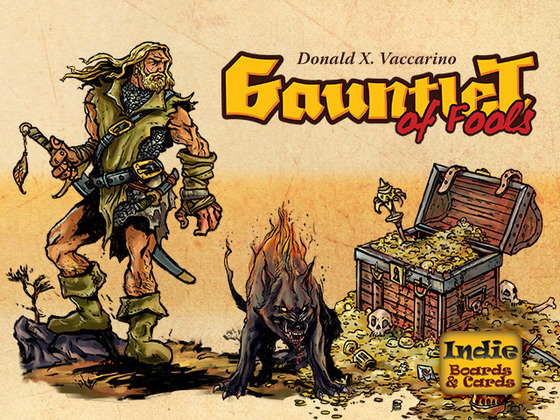
Running the Gauntlet Of Fools

by Firestone

Donald X. is the incredibly successful designer of hit games such as Dominion and Kingdom Builder. His latest is nothing like Dominion at all, but don’t let that stop you from playing this fast, fun game.

Gauntlet Of Fools comes with:

  • 90 cards—divided into 20 Class cards, 20 Weapon Cards, and 50 Encounter cards.
  • 30 dice
  • 4,000 tokens—okay, that’s an exaggeration, but there are a BUNCH of tokens.
  • 1 Playmat on which to place Boasts before they’re taken.

You’re going to control a hero, who will enter the dungeon, and who will die. (Well, you'll almost certainly die, unless you get really, really lucky. But plan on taking dirt nap...) Your goal is to end up with more gold than your opponents at the end of the dungeon.

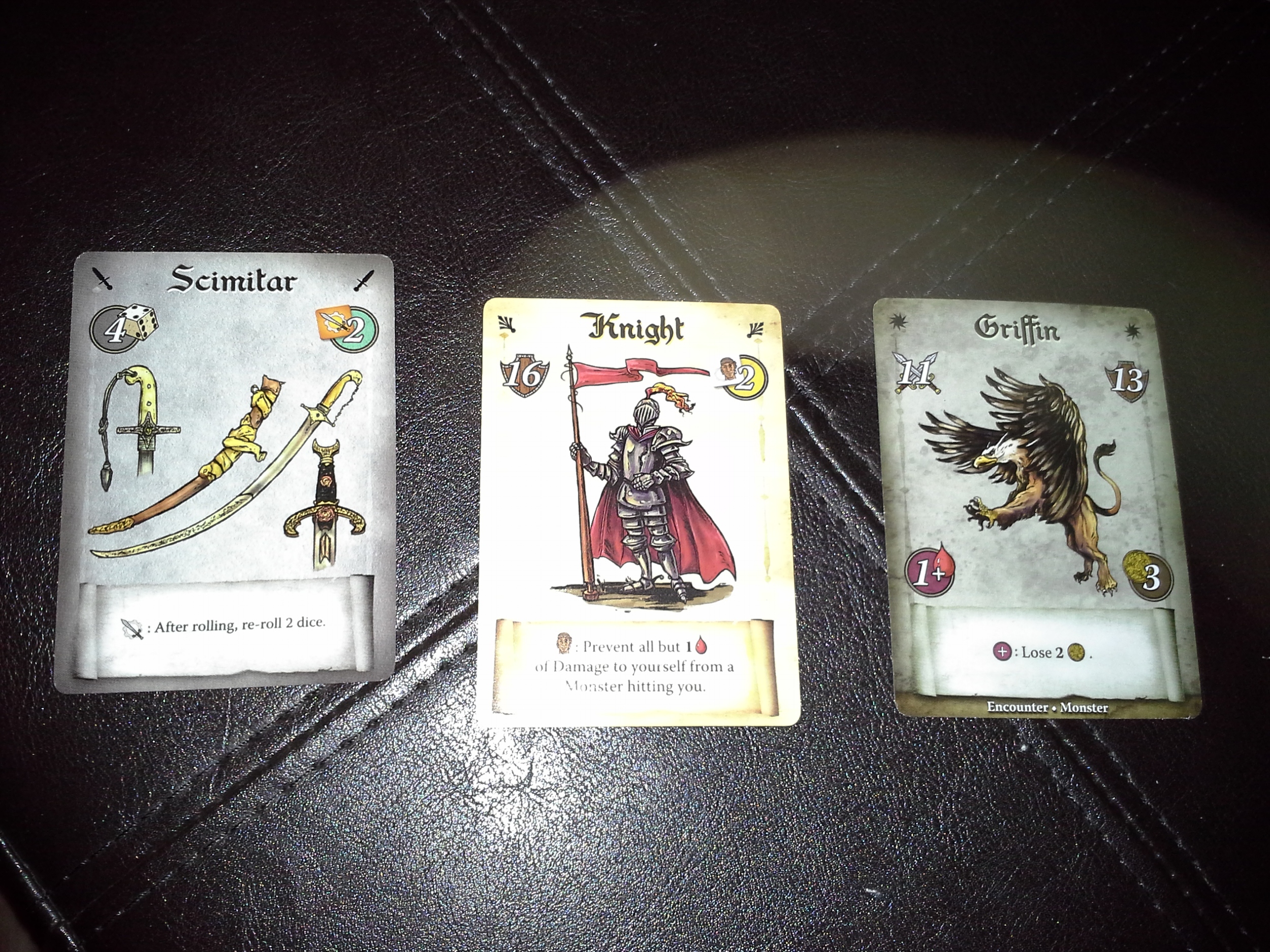
First you deal out one Class card per player; they’re the Heroes, and include ninjas, barbarians, zombies, and jesters. Each one of them has an inherent defense, and a special power that you can use in the dungeon. Then you attach one Weapon to each Hero; they include spears, axes, whips, holy swords, and deadly fists. Each one has a number of dice you will roll for your attacks in the dungeon, along with a special power. Every game the Heroes and Weapons combinations will be different, so there’s plenty of replay value here.

Heroes and Weapons have special powers, and while you can use a few of them automatically, almost all of them cost an Ability token. The number of tokens varies based on the power (with a low of zero and high of 20), but on average you’ll get two Class Ability tokens and Two Weapon Ability tokens.

You should be aware that there are some “darker” cards in these, such as necromancers, zombies, and demonic blades. Their power is abstracted, but they’re there; if you felt strongly about it, you could easily remove those cards from the game without really affecting anything.

There are two phases to the game: the Boasting Phase and the Gauntlet Phase.

First comes the Boasting. Starting with the start player, each person takes one of the Heroes—and the Weapon attached to that Hero—and places it in front of them. If they think the Hero might get taken from them, they can attach a Boast to it, but it’s not required. Now the next player takes a Hero. If they take one that’s already in front of another player, they have to attach at least one Boast to it. That continues until each player has a Hero in front of him or her.

The Boasts include things such as “One Arm Tied Behind My Back,” which means that when the Hero is in the dungeon, he’ll ignore all 1s and 2s rolled on the dice. Or while “Hopping On One Leg,” which means you reduce the Hero’s defense by two. Or “With A Hangover,” which means you reduce your Hero’s attack dice by one and defense by four, but as soon as you kill a monster you get rid of the Hangover—fighting sobers you up! There are a few others, too.

So you can take the Hero someone else has, but you’re going to “pay” more for it—in the form of Boasts. And you might really want a Hero, but you have to ask yourself if it’s worth all the Boasts. It generally feels that a Great Hero with a Great Weapon—and a Boast or two—is more valuable than a Good Hero with a Good Weapon. Of course, that’s not always true, and some Boasts feel more harmful than others. It’s a sort of auction, where you’re valuing what’s out there, and trying to do a better job of valuing than your opponents—it reminds me of the province auction in Amun-Re.

Now comes the Gauntlet Phase, where you fight the monsters. And die. Early on, people were comparing this to Munchkin, and that scared me off. I can’t stand Munchkin—for lots of little reasons, but the big one is that the games often take FOREVER. FOR. E. VER!!!  Gauntlet of Fools is only superficially like Munchkin (fight monsters in a dungeon), but it’s also got a natural timer to it. You’re going to die. Everyone’s going to die. You might live one or two rounds longer than someone else—or vice versa—but that’s it. This keeps games at around 20 minutes, and that’s just perfect for this weight and type of game.

Anyway, you play a series of turns, and in each one you determine the encounter (draw the top card of the Encounter deck), attack the monster, defend against the monster, and then check to see if you’re dead yet. Most of the time the Encounter will be a monster of some kind. Each one has an attack strength, a defense strength, a gold amount for if you kill it, a wound amount if it hits you, and finally a special power. They’ve done a good job of conveying a lot of info in a clear way on a single card.

There are a few special Encounter cards. There’s a Spear Trap where you automatically take a wound, and some modifiers that make the next monster worth more gold, or have extra defense, or extra attack power—or do double damage. There are also some good Encounters that give you gold, or tokens you can use on your special powers, or allow you to heal a wound.

So for each regular Encounter your Hero will roll however many dice he or she has for attack, and if the total is as much or more than the monster’s defense, you’ve killed it, and you get the gold. Even if the monster dies, it still gets to attack your Hero. Again, if its attack equals or bests your defense, you’ll take one or more wounds. This attack and defend portion is where you can also use those Ability Tokens you got with your Hero. You might be able to turn one in and automatically kill any monster, or turn one in a roll an extra attack die, or turn one in a reroll all attack dice.

So there are definite decisions to be made in the Gauntlet. When should you just attack, and when should you spend a precious Token? Will I die this turn, and can I somehow prevent that?

Eventually everyone dies (four wounds and you’re dead at the end of the turn), and you count up the gold; whoever has the most gold wins. That’s not necessarily the person who lived the longest. If I was able to kill a couple of big-money monsters—but died early, that could be better than you living a longer time, but only killing monsters that give you one gold.

That’s an exhaustive look at the game. It probably took you longer to read this than it will to play a game. (Okay, that's an exaggeration...)

So what do I think? I like it! It’s a fast and fun dungeon delve. Some people don’t like that you only Boast once and use that one Hero through the whole Gauntlet, but it’s meant to play quickly and easily, and that’s just what it does. Want more? Play another game! Want Mage Knight? Play Mage Knight!

The dice add a lot of uncertainty. There were plenty of times that a Hero should be able to best a Monster, but then he'd roll a bunch of 1s and 2s. We played once, and then we immediately wanted to play again. And then we played another after that.

If there's one thing I'm uncertain about, it's that I'm not sure how well this would go over with nongamers. Auction games might be the hardest genre to bring out with Grandma and your Aunt Fanny. It's hard to figure out just how much something is worth, and if they undervalue or overvalue something, it can kinda throw the whole game off. But Gauntlet's light enough and fast enough that I'm far less concerned with this than I would be with, say...The Princes of Florence.

There’s plenty of room for expansion with this game, and I’ll eagerly add them if and when they come out. In the meantime, I’m going into the Gauntlet with my mace-wielding knight—unfortunately, he’s blindfolded and he skipped breakfast…

Our thanks to Indie Boards & Cards for graciously providing a review copy to Theology of Games.

Robinson Crusoe - en anglais

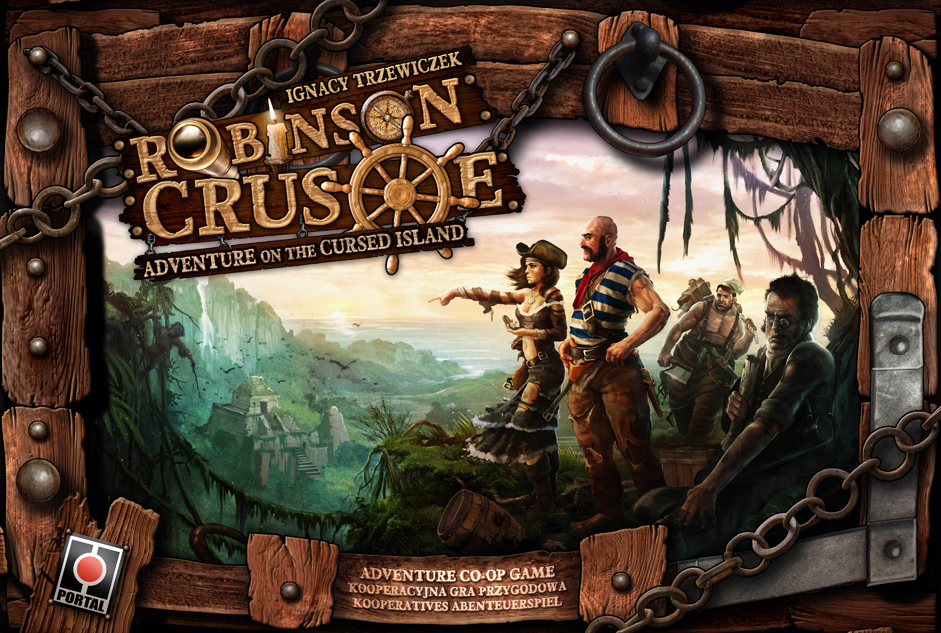
Earlier this year Z-Man Games announced that they will be publishing, in conjunction with Portal Games, Robinson Crusoe: Adventure on the Cursed Island, in English. The English edition will premiere this month at Spiel. In what appears to be a top notch co-op game, players work together, discuss strategy, and learn to make sacrifices for the good of the team. Everything about this game hits home with me; can't wait to pick up a copy of this one!

For more news you can check out the title over at Z-Man's website, RIGHT HERE!