Days Of Wonder Announces Ticket To Ride: 10th Anniversary Edition

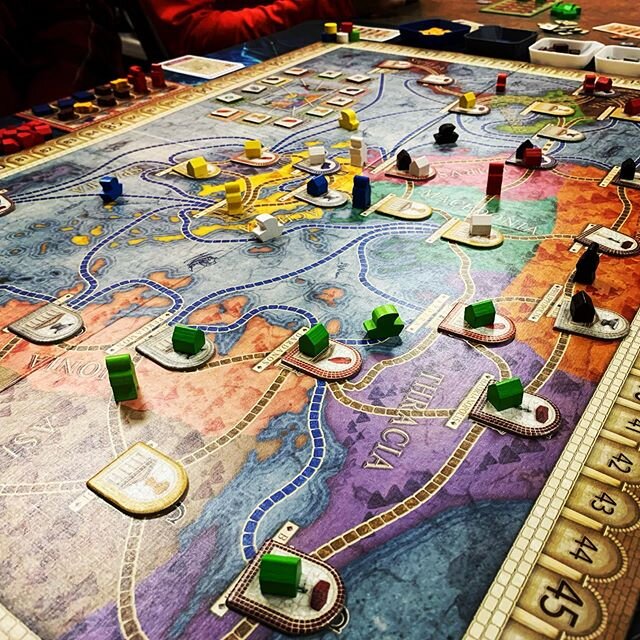
T2R-10th-boxBy Firestone It's the perfect gateway game. It's the game my Mom wants me to bring to every holiday get-together. It's often mistakenly called "The train game"--also by my Mom. And it's turning 10 years old...with a shiny new edition.

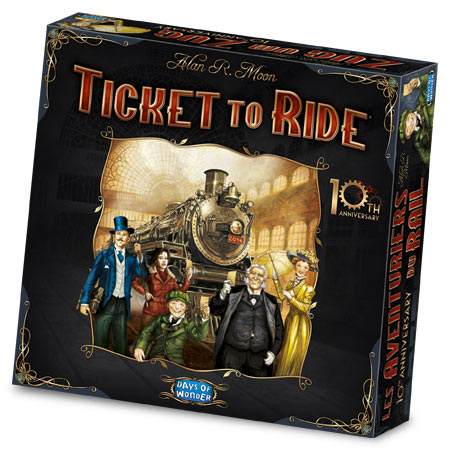
Days Of Wonder has announced the 10th Anniversary Edition of their blockbuster bestseller.

Ticket_boxesThe game will come with in an oversized box, with new cover design and graphics. And the new and redesigned board will be 50% larger than the original.

The box will also include:

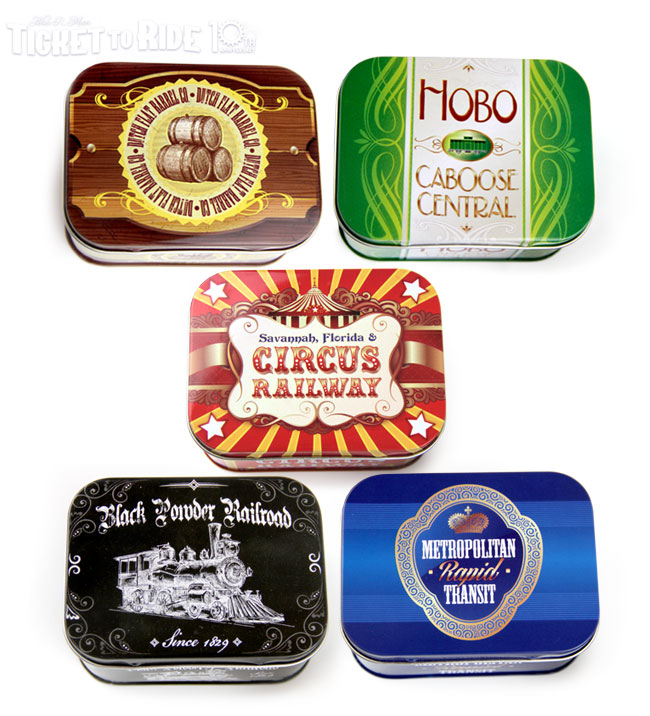
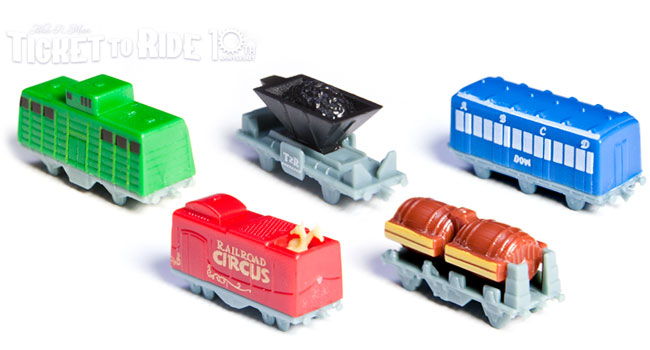
  • 5 Tin Boxes, each with 48 finely sculpted trains
  • 5 Wooden Scoring Markers
  • 1 Multilingual Rules Booklet
  • 110 Train Cards with all new illustrations
  • 30 Classic Destination Tickets
  • 35 Destination Tickets from USA 1910
  • 4 Destination Tickets from Mystery Train
  • 1 Longest Route/Globetrotter Bonus card

Ticket_trainsThose trains and tins look really cool! It drops in June, but start saving your pennies now: it'll cost $100...

Hegemonic--A Double-Take Review

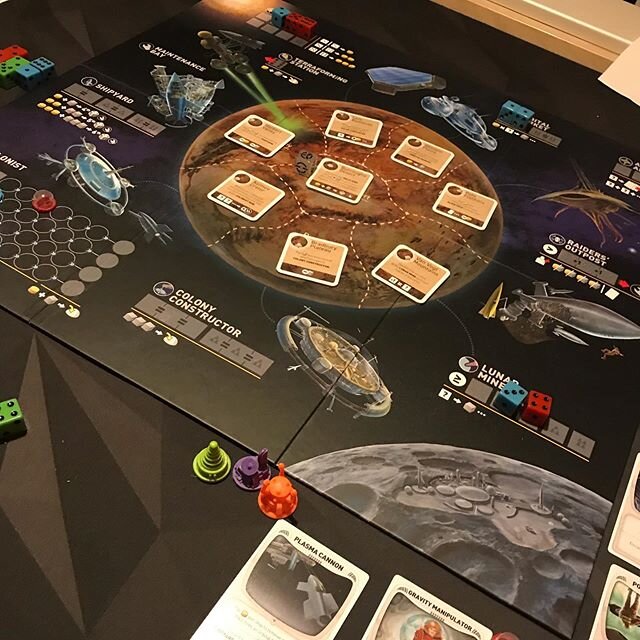
hegemonicSpace, the final frontier... Hegemonic is a new 4X game for 2-6 players from Minion Games. For those who may not be familiar with 4X games the four X's stand for eXplore, eXpand, eXploit and eXterminate. So maybe they should be called 4-eX games? Anyway. Hegemonic takes place in space, as players act as the rulers of different "houses" looking to expand their reach and control in the galaxy. What did we think of Hegemonic and the final frontier? Let's take a look!

The Overview

Like most 4X games, you'll start with a little, and grow your space, units, and power--eventually clashing with other players. But unlike most 4X games, this is done with influence, and not big fleets and the roll of the dice.

Hegemonicsectors

There are TONS of pieces, parts, and cool bits to this game. We'll list them here, but if you'd like to see them live and in video. Click here to see our unboxing video on YouTube.

1 - Galactic Core Board, which is the center of the game play and has a turn order tracker on it.

9 - Five-Sector Galaxy Boards - The five sectors are hexes, and you use a certain number of these boards depending on the number of players in the game.

The bits - there are an even number of all of these split into six colors -blue, green, orange, purple, red, and yellow.

90 - Industrial Complexes - two of these are used for score tracking.

54 - Political Embassies

72 - Martial Outposts

18 - Quantum Gate pairs

18 - Political Agents

18 - Fleet Units

1 - Score Tracker Board

The Galactic Center!

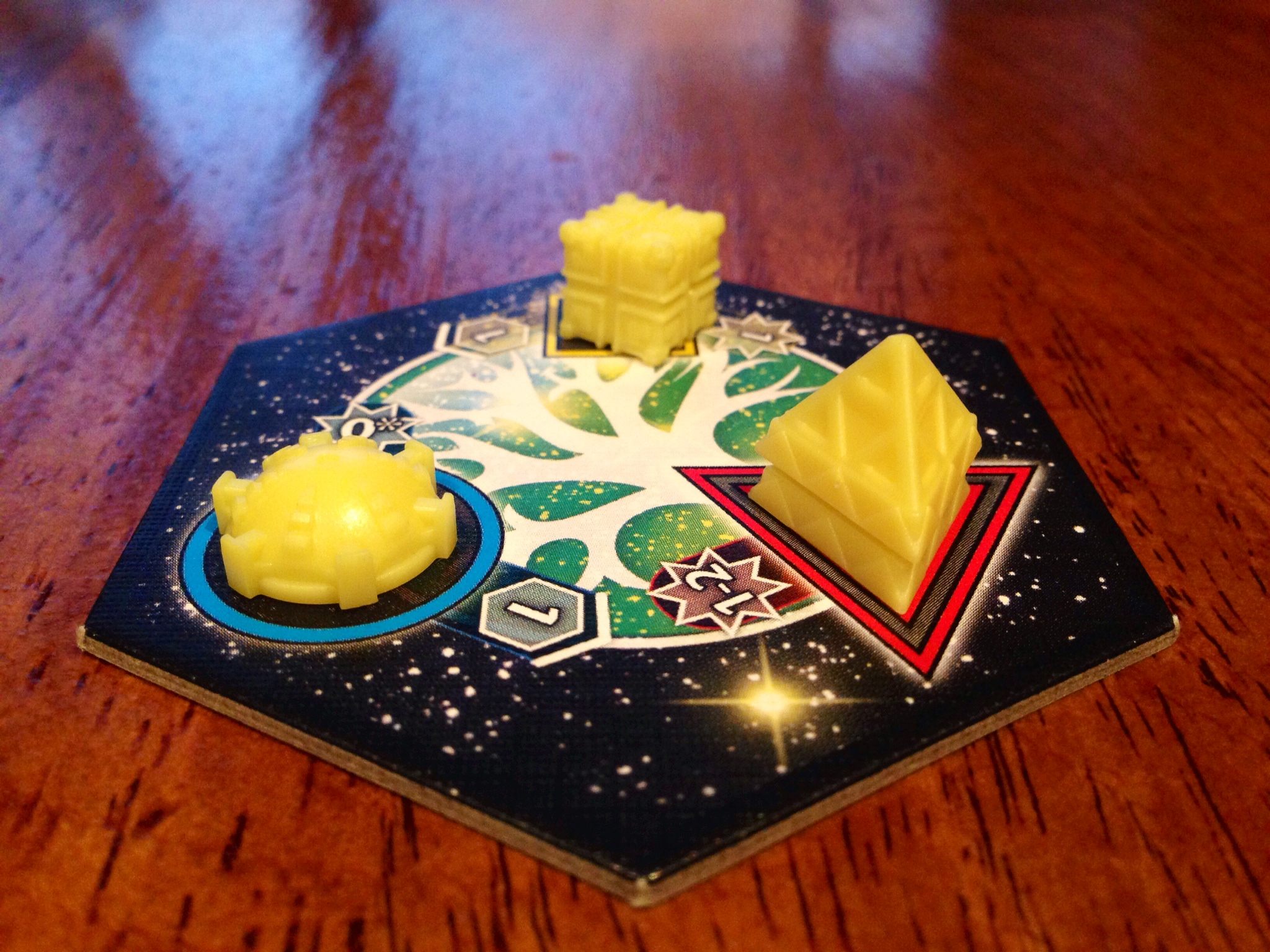
48 - Sector Tiles - These have an assortment of possible bases that can be built on them of varying powers and ranges; this will all make sense shortly. Some of them also has a background color, which means it's part of one of three different Factions that can lend support in conflicts.

36 - Action Cards - This makes a set of six cards per player; they're all all the same set of cards, but they have different colors to let you know who played what.

54 - Tech Cards - This is a deck of cards with technology on them that can be advanced, or power values that can be used to help you win a conflict.

1 - Arbiter Token - This is the 1st player token but also has some benefits in game play.

12 - Leader Cards - These are optional and add some more options to the game play.

81 - CAP Tokens - this is the game's money

6 - Player Board - Very cool two-layer boards that hold all of your bases and show how much each costs to build, how much money you can keep at the end of a turn, and how much you gain at the beginning of the next turn.

The Setup

There are examples for setup, depending on how many players are in the game, but it should be noted that there is also a specific number of sector tiles and boards to put into the game.

Eight sector tiles are randomly selected per player, which create a draw stack. Choose a start player. Each player places his or her starting tile--each color has one on--the board. There are suggestions on where these should be placed, and they cannot be placed on the Core Galactic board. Each player then places one Industrial Complex, one Political Embassy, and one Martial Outpost on that starting tile. Each player then in turn draws two tiles and plays one adjacent to their starting tile--this one can be placed on the Core Galactic board--and then places the other one face up next to the draw stack, which creates the "Sector Pool" that will be used for the remainder of the game. Then each player is dealt two cards from the Tech Deck.

The player board.

The Gameplay

After you've set up, play moves through six different phases. The first two phases start with the Arbiter, and then things get interesting. Here's a quick rundown of the phases.

Phase 1: Collection--Players receive CAPS equal to the highest "gain" number value for each track on their board--Industrial, Political, and Martial--that has an empty spot on it. In other words, the more they've built from one of those tracks the more money they get at the beginning of the turn.

Phase 2: Expansion--This is a pretty simple step. You draw one tile from the Sector tile draw stack, place it faceup in the Sector Pool, and then select any tile from the Pool to add to the board. It can be placed on any empty space, except for the very center space where the turn order tracker is.  Then you draw two cards from the tech deck, and either discard one of them, or pay the cost denoted on a card to advance that technology. You also can only advance a tech if you have built that specific track to the particular tier denoted on the card--for example, if you've built your martial track into the second tier, but the card requires a martial tier of three, you can't advance that technology just yet.

Phases 3-5: Action Phases--All three of these are identical. You'll be playing an Action card from your hand, resolving the cards in the order of the number on the card (they're 1, 2, 2, 2, 3, and 4), and then getting your card back. You do this three times, and then move on to the next phase.

Phase 6: Arbitration--At this point in the game, whoever has the most money receives the Arbiter token. Then players pay money to the general supply until they have no more than the lowest "retention limit" value that is revealed on their board. These show up in the spaces that you build your bases from. The more you've built, the less you keep at the end of the turn--think of it as administrative costs for your growing empire...

And then you score points at the end of each turn. Players add up their power (or influence) on each 5-sector board: Whoever has the most gets six points, whoever has the second most gets three points, and if any other players simply have presence there they get one point. You get an extra two points for being the only player on a board, and an extra one point for each score awarded on the Core Galactic board.

Then you go back to phase one and do it all again.

The game ends on the round that the board is filled. The board is scored one last time and whoever has the most points wins.

You can really see the two levels of the player boards here. Very cool...

Action Cards

We really need to take a minute to explain some of the Action cards, because this  is where the meat of the game lies. There are a lot of options, and a ton of housekeeping that comes with the Action Phase, so let's dig in.

Each Action card has several actions you can choose from, and all of them allow you to choose up to two Actions. Most of them have a Basic action that allows you to use one of the actions to gain two Caps, or draw one tech card and advance one or discard one.

Here's a quick overview of the cards:

Assault - 1 - This action allows you to attack from one type of base to a non-alike base, for example you can attack with a Martial Fleet to an Industrial complex or Political Emabassy. This is a "Destroy" action so doing this only weakens your opponents and you don't take over the area you assault.

Industrialize, Politicize, Martialize - 2 - All three of these cards have the same number, and each does the same thing but for a different area of influence: Industry, Political and Martial. This Action card allows you to choose from the Basic action, or to build new bases -of the type you selected--and/or gates, fleets, and agents. Each base built has a "range" and "power" value printed on the tile you build them on, ranging typically from 1-3.

You can also choose to attack and "Takeover" the same type as you are building this turn. This allows you to not only weaken your opponent but allows you to takeover and build the same type of base you just destroyed.

Subvert - 3 - This action card gives you the Takeover ability of the number 2 action cards, but you can do it with non-alike types of conflict--like card number 1, you can attack Industrial and Political with Martial power.

4 - Discover - This card gives you three options: Capitalize, which lets you to gain more money--often a power play to gain the Arbiter token next round. Survey, which allows you to add another tile from the pool to the board. Research, which allows you to discard and redraw Tech cards.

We feel we should also spend some time on the conflict-resolution mechanics of this game, this is where the game grinds to a snail's pace.

There are three distinct battle systems used in Hegemonic. Which one you use depends on what power you are using for your attack - Industrial, Political or Martial. And each of those areas has a unique defense value that is totaled.

When you attack with Martial power you must have a fleet in play, then pay to move that fleet, and pay to attack--based on the power of the base you're attacking. Then you calculate the attack power of your fleet by the number of one base that has the "range" to reach the fleet, and all of the bases that have the "range to reach that supporting base --and your gates can add other bases because they create adjacency and add your fleet's power, which is denoted on your player board and dependent on the tier you have reached on the Martial track . You then add up the total defense power of the defending outpost, which is simply adding the power of the defending  outpost, along with any  outposts that can reach it with its own range, along with any outposts that are within the defending outpost's range, and the power of any fleets that may be on the defending outpost's tile. Then you add the power of one tech card--using the icons on the bottom to match the type of conflict--and then total up the power and see who wins. It's THAT simple!

Industrial doesn't have fleets or agents so you can only attack within one complex's range adding attack and defense power from outposts that are within range, and a tech card from each player's hand.

And Political conflict is much like Martial conflict except you move your agents and only draw support from political embassies that are within range of your agent and then those around the board that are on the same Faction (color) as the supporting embassy.

There are a couple of advanced rules options, including Leader cards that let you do some really fun stuff.

The Verdict

The boards with pieces set into the notches.

Jeremiah--Let's talk about the components first. Everything in the box is really top notch. It's very well designed both artistically and graphically. It's a really great game to look at. The way the Martial outposts stack is cool in both form and function. The player boards are great and ingenious too. All the plastic mini bits just fit and work. My chief complaint about the components has to fall upon the rule book. The layout and explanation of the conflict, especially, leaves a lot to be desired. The gameplay is really complex with tons of moving parts and things to keep track of, and having anything short of an amazing rule book to reference was very frustrating at times.

Firestone--I agree on the components. I was blown away by the 2-layer player boards. All of your stuff fits right in the spaces, and if you bump it you won't have to spend 10 minutes righting everything. The plastic bits are cool, and I totally agree: The stacking Martial Outposts are cool. The Sector tiles are colorful, and interesting, and convey a lot of information using colors and icons in a nonobtrusive way.

Jeremiah--The expanding and exploring portions of Hegemonic are really, really cool. It all made a lot of sense, and was fun to plot out what you could do on your turn and think ahead and try to figure out what the other players were looking at as well. The monetary system works really well too. As you build you find out how necessary it is to build evenly, and the more you build there's a good chance you'll lose out on being the Arbiter because the cost to build increases as well.

Firestone--One of my favorite things about this was the Sector Pool. I really dislike the randomness of the tile draw in Eclipse. "Hey, I drew a crappy one! Hey, you drew an awesome one! Good for you!" Blech. Now, it can absolutely still happen that an opponent will draw exactly what she needs, and you won't, but at least you're not stuck with the one tile you drew. There are always options in the Sector Pool, and that tile that was useless to your plans earlier might be important to your plans now...

Jeremiah--The battle system, though, made the game feel unnecessarily bogged down. We trudged through each and every conflict, and had to dig into the rule book to find answers. I understand: There are three different types of power on the board, and they all use their power differently. Awesome. But there is just SO much to keep track of, it really kept us from wanting to attack the other players, which kind of stinks in a game that's designed to be one quarter eXtermination.

Firestone--Yeah, the conflict resolution is CONVOLUTED. It's not enough that you're trying to figure out what you need to do, and what you think your opponents might be trying to do, but when you add on this extra layer of conflict resolution, it's enough to make your head explode. Just like Jeremiah, every time there was a conflict, we'd have to go through all of it, step by step, and resolve it. Anther problem was that even if you were THINKING of attacking someone somewhere, you had to figure this whole thing out by yourself, because you didn't want to telegraph your move. But that meant more time, and a greater chance that you'd screw something up since you're doing it alone. "Okay, so if I attack there, I'll have to do it with that power, so I'll have to play this card. So now we add up his power, and then mine comes from there, there, and...there, so that's...and then I'll have to play this card, and hope he doesn't have that card..." Ka-BOOM!

I know it sounds like we didn't like it, but I like everything but this aspect. Unfortunately, this aspect is a huge part of the game. This isn't enough to keep me from playing the game, and I think it will get easier as you play more. It's just something you should know going into it.
HegemonicSector1Jeremiah--Our game group is split pretty much right down the middle about Hegemonic. Myself and a few others liked the game and see how much fun it can be. Others just couldn't abide the intricacies and the multiple battle systems, and all the housekeeping that went into it. I will say there is nothing in this game that makes it unfriendly to family players, or deeply offensive, other than the very involved and intensive learning curve. The theme is fun and exciting, but the game is long and laborious; many casual players will not make it halfway through the instructions.

Firestone--Yeah, this is a gamer's game for sure. I played twice with gamers, and they all thought it was pretty good, but they were all put off by the conflict resolution. Some of them would play again (as would I), but some would be fine never playing again.

One good thing was that our first game was with four brand-new players, and we finished in just over two hours. That's just not happening with Eclipse and Twilight Imperium III...

In the end, this doesn't feel much like a 4X game to me. Sure, you're drawing tiles and expanding and taking things over. And there's technology, and all of the things you'd expect in a 4X game. It just didn't feel like one... What it really felt like was an area-control game--El Grande if El Grande decided to do CrossFit, maybe...

Jeremiah Final Verdict--Hegemonic is not for the faint of heart. I have to give this one somewhat of the benefit of doubt. To be fair my game group does not often play 4X type games, it's mostly Euros, cards, co-ops and the like for us. So this was a pretty new experience, and deeper level of strategy game than most of us have played. I get the feeling a few of us may get together and sit down with this one and really enjoy it. But a table divided can not stand, so we had a rough time getting through this one a few times. The art, concept, and deep mechanics are well thought out. Maybe a little too well thought out. Don't even think about putting this on the table with kids, family or casual gamers; it's simply too much for those situations. If you're into 4X games, and love deep, and at times tweaky mechanics, this will be right up your alley, so in that setting, I say Put This One on the Table.

Firestone Final Verdict--I'm very conflicted on this one. The components are top-notch. The art direction, and "small" decisions, such as having three distinct shapes for the powers, and stackable martial triangles, are inspired. It doesn't much feel like a 4X game to me, so it's not going to replace Twilight Imperium III. And while I like area-control, this one has such complex resolution on conflict that I would rather just play a classic such as El Grande. But I still liked Hegemonic! I just didn't love it. There's very little luck. It's interesting. It looks great. It's obviously well-thought-out. As long as you have the correct expectations going in, I say Put This on the Table!

We'd like the thank Minion Games for providing review copies of Hegemonic. This in no way affected our opinions on the game. 

Thanks for reading! Please check us out on Twitter, Facebook, and YouTube.

oddball Aeronauts--A Double-Take Preview

oddballlogoYou're at the doctor's office. Or the DMV. (Shudder...) Or in line at at amusement park. Or waiting to buy tickets to a Radiohead concert. You're bored. You don't have a surface to play a game. But you have the sudden urge to battle it out for pirate-like supremacy of the air. What will you do?! I have just the thing...

The Overview

Oddball Aeronauts is a 2-player card game where you're trying to force your opponent to discard all of his or her cards. It's for ages 9 and up (which seems about right), and plays in about 15 minutes.

Everything you need to play the game. No...everything.

The Components

Note: We were sent prototype copies of the game. The quality and exact component list may change before publication.

Cards... That's it. No tokens. No nothing. Just cards. The cards are broken into two types:

Faction Cards - There are 2 decks of 24 cards per Faction. These cards have 3 skills listed on them - Sailing, Guns, and Boarding. Each of those skills has a primary "Skill Level" and a "Skill Bonus." We'll tell you a little more about that in a minute. These cards also have Special Abilities that will either affect this turn, or the next turn.

Event Cards - There are a total of six Events in the game, but with rule updates only three of them will come out in the game play. These Events come into play from one player's deck but affect the whole game and both players have to deal with its effect.

The Setup

Give each player a Faction deck, and randomly shuffle three Event cards into one of the decks. Players then hold their deck face-up towards them so they can see what is now the top card's face. The rules say to play Rock-Paper-Scissors to determine the starting player--the starting player is the one who loses. And you're ready to go.

The Gameplay

The game is played in rounds, and each round is essentially a portion of a battle between two rival Factions.

Before we go into how the game actually works, there are some interesting concepts and actual physical mechanics that should be noted and understood. As you probably noticed, the entire deck is being held by each player at this point. The goal of the game is to get the other player to discard all of their cards. It's a war of attrition. When a player discards a card they turn the card face down and puts it at the bottom of the deck. Once one player gets to his or her first face down card, they've exhausted their deck--and lose. Certain abilities and round results will allow players to recover a card, and in this instance players search down in their deck to the first face down card and then turn it face up, thus keeping more cards in the game. Some have an ability to add a bonus in the next round after it's discarded. They've printed this bonus on the back of the card in the top corner, so in this instance the card is discarded and then pushed up to reveal that bonus for use in the current round. There are also some abilities that take effect that round, and use the same mechanism to reveal the ability to your opponent by pushing the card up, without revealing the face to them.

One of the Factions...

The rounds are broken down into 5 phases:

1. Events -- If the player with the Event cards has an Event in their top three cards, it's brought out and dealt with. Or continues its effect on the round.

2. Announce Skill -- At this point each player will fan out their top 3 cards, and determine which skill they will use--Sailing, Guns, or Boarding. You're allowed to look past your top 3 cards to see what is coming up next, but you can only use up to your top 3 cards. Once both players have decided what skill they will use, they announce it and the next phase commences.

3. Play Cards -- Like we just said, you can choose to play up to 3 of your top cards. By playing more than one card you are supporting the top card in the fight. So you'll be using the top card's "Skill Level"--which is the big number on the top for that skill--but for the cards below it you'll be using their "Skill Bonus" value--which is the smaller number on the bottom of that skill. You also can only use the special ability of the top card. Once both players have decided how many cards they will play, the lead player--the one who lost Rock-Paper-Scissors--will count to three and each player will hold up X number of fingers: X being the number of cards they intend to play.

4. Winner of the Round -- Players reveal the cards they are playing, and show the total of their Skill, by adding up Skill Level, Skill Bonus and any Special Ability Bonuses that may be applied, and the player with the highest level of Skill wins the round. If there should be a draw, then no one wins and the cards are discarded.

5. Win Result --After one player is declared the winner of the round, both players discard any cards they played, and then you resolve the results. If the winning player used Sailing, they recover 2 cards. If they used Guns, the loser discards 2 additional cards. And if they used Boarding, the winner recovers 1 card and the loser discards 1 additional card.

The winning player starts the next round as the Lead player and you do the whole thing over again.

After all of the effects have been resolved, if a player has no more active (face up) cards, they lose; if both players have no more active cards, it's a tie!

The Verdict

Even the unfinished art is cool!

Firestone--What a terrific idea! I have no idea if someone's already thought about making a game that needs no surface to play, but who cares? It's great. I'll definitely be grabbing this game on trips and hikes and any travel I have to do.

Jeremiah--Yeah, I'm sure there are a few micro games out there that don't use a playing surface, but this is much more than a micro game, and I love the idea. You could easily play this on a table and lay down the cards you're playing for a round. But I love the thought that went into making it work without a playing surface. I played this with a friend while we were sitting on my couch. That's just cool.

Firestone--Yes, steampunk is all the rage now, so there's a part of me that wants to avoid everything steampunky, just on general principle. But I can't help myself! The artwork is really cool and evocative. The characters are interesting, and I'm kind of a sucker for anthropomorphic animals... Let's make this into a kick-butt cartoon!

Jeremiah--Yeah, I'm okay with the Steampunk movement for now. It's creative and imaginative, and it's just cool to look at; this game is no different. Steampunk is very much the Japanese Animation of this generation. I remember when Akira hit these shores; it was unlike anything anyone had ever seen and it blew up from there. Steampunk is riding that wave; I'm sure it will settle before long, but its carved out its niche and I'm sure it's here to stay. Lucky for us it doesn't involve sparkling vampires or any other lameness...

Firestone--With a box that small I wasn't expecting to be thinking too much, but there are definite, actual decisions to be made. Interesting decisions. You're always having to look at the next few cards and try to figure out the best way to play them, and when to tiptoe, and when to bum-rush.

Jeremiah--I totally agree. With not needing a playing surface, and holding all of your cards, I was really thinking along the lines of a streamlined micro game. But it's really not. Is it a 3-hour Euro? No. But the fact that you can plan ahead, and potentially throw a round so you can maneuver a card into a position to really slam your opponent hard in the next round, is a great mechanism, and adds a ton of strategic decisions to make. None of them are too deep that you get analysis paralysis, but enough to make the game really interesting and fun.

Jeremiah--If there was one thing I would add to this game components-wise, it would be something like three stones/tokens for each player. So instead of counting to three and sticking up your fingers, you would reach into your pocket and pull out a number of stones to reveal how many cards you're playing that round. It seems piratey to reveal stones in your hand, and wouldn't clutter up your non-existent playing area. But the fingers work fine.

Firestone--I've played this with adults, and they all thought it was clever and fun. Not super deep, but who wants to play Tigris & Euphrates at the doctor's office? I also played with my 9-year-old, and he loved it, once we got past the rules, which were a little hard for him to grasp at first. But as he was making his way through his deck, he kept seeing the next picture and saying, "Oh cool!" or "Aww....look at that one, Dad!" And then I'd have to remind him that he probably shouldn't show me his cards...

Jeremiah--I haven't played this one with either of my boys. My oldest could probably grasp it, and it would be good to work his math skills. Thematically and visually though I can't imagine many people that wouldn't think it's cool, including kids. The cards are just really cool to look at--very richly designed!

Firestone--I hope they come out with expansion cards, and maybe a way to customize your deck a little. It doesn't need that, but it would be fun, and give it some legs for the long-haul.

Jeremiah--I kind of don't want to see deck customization in this game; I feel like it could get unbalanced really easily, or just convoluted too much from what it is. It's a quick-playing game that you can throw in your pocket, laptop bag, etc. I'm sure there will be an expansion or two down the line--more events most likely--or maybe even another two decks that bring out more Factions. If there was a way to bring more than 2 players into the game, I'd be all for that, as long as it wouldn't break the game, because I really like it the way it is.

Firestone Final Verdict--oddball Aeronauts is a unique game. The footprint, artwork, and gameplay all combine to make a game I'm happy to play wherever I am. Even the DMV! I would say put this on the table, but it doesn't need a table! That's awesome!

Jeremiah Final Verdict--We totally agree on this one. oddball Aeronauts packs a lot of fun and strategy into about 15 minutes of gameplay. The unique mechanics and card design/layout seamlessly serve the purpose of the game, and don't come off as gimmicky at all. This a great play-it-anywhere game and yes, it doesn't need a table so, just go play it already!

oddball Aeronauts is on Kickstarter right now! They've got a little less than three weeks to go, but they're nearly funded! Yay!

We'd like to thank Maverick:Muse for providing preview copies of oddball Aeronauts. This in no way affected our opinions, and this was not a paid preview.

Thanks for reading, don't forget to find us on the interwebs!

Facebook, Twitter, Instagram, YouTube and our Podcast!

Bottom Banner

We Interview Crash Games' Patrick Nickell, and Designer Jason Kotarski, About their New Games

cg_logoToday we’re joined by two gentlemen who are, in their own ways, shaping the face of indie gaming as we know it today. Patrick Nickell, founder, el presidente, and Grand Poobah of Crash Games. And Jason Kotarski, designer of last year’s Great Heartland Hauling Co., which made our top 10 games of 2013 list.

Patrick, Jason, thanks for joining us today!

Before we go much further Patrick can you give us a quick recap of 2013 for Crash Games?

Patrick: It was a busy year for Crash Game in 2013. The best way for people to see what we accomplished is to check out our 2014 State of Crash Games at http://eepurl.com/N1wG1

Some of the highlights include: 1. Shipped out The Lost Dutchman to backers worldwide

2. Kickstarted Paradise Fallen and shipped it out to backers worldwide.

3. Kickstarted Council of Verona and shipped it out to backers worldwide.

4. Kickstarted a true, pay-what-you-want campaign for Where Art Thou, Romeo? and shipped it out to backers worldwide.

5. Attended six conventions including Spiel in Essen Germany.

What was the biggest surprise of the year for you?

P: Council of Verona, and how amazing and fast the project came together. I had a great game designer in Michael Eskue, a phenomenally talented artist in Adam McIver, and my awesome graphic designer, Darrell Louder, was able to wrangle everything together. And my manufacturer Panda Games did a good job of making things happen in a very short amount of time.

Jason, since the release of Heartland Hauling, you haven’t been resting on your laurels--you’ve been working away, designing. How many designs have you completed since then, and how many are you working on currently?

Jason: Since Heartland came out I caught the bug. That was the first game I ever designed, but since then I’ve been working on something like 8-10 more. I published a game called FrogFlip with Sprocket Games, and another game is coming this spring from White Goblin Games, as well as another half dozen that are in varying degrees of development. It’s a fun space to create in. An idea pops up and I know pretty quickly whether or not I have to work on it. Then, I get to it until I get stuck and move on to something else until I get unstuck.

Now, you guys have known each other for some time, but you most recently sat down and talked business at Unpub 4. And there’s some big news that came about from those talks...do tell!

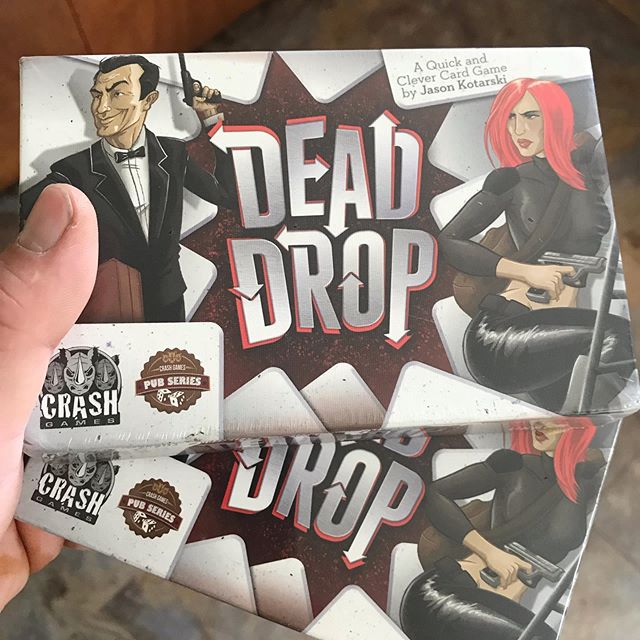
P: I have been a big fan of Jason’s ever since hearing his story back when he first met up with Dice Hate Me Games and recorded a “State of Games” episode on Chris’ podcast. I backed Great Heartland Hauling on Kickstarter and have been enjoying playing it to this day. Jason and I always chatted at various conventions and I felt we had a really good vibe going. When we met up the evening before the official kick-off of UnPub4 I had the opportunity to play Dead Drop and I really enjoyed playing it. Later in the weekend I heard all the commotion inside the venue and went over to discover that it was coming from another of Jason’s games, this time it was Sunset Shuffle. After playing the game I knew that it fit a very specific type of game I was looking to add to the Crash Games catalog--not to mention IT WAS A BLAST! I was very happy to walk away from UnPub4 having signed both Dead Drop and Sunset Shuffle, which I am now calling Sunset Showdown.

This is really cool news! First, let’s talk a little bit about Dead Drop. Jason can you tell us a little bit about the game, and how it plays? And Patrick, what drew you to the game and made you decide to publish it?

alias_tv_showJ: I guess Dead Drop started as a way to explore the microgame space a bit. I had a lot of fun making FrogFlip with my daughter, which consists of just 12 cards, and wanted to dig in a little deeper and out of my comfort zone. The idea hit me as I was watching the Alias television series this past year with my wife. In the show, the secret agents were always leaving sensitive information for each other in public locations. It was a way to pass on key information while keeping the agents’ identities a secret. So from there I worked on the idea that various organizations were racing to be the first ones to discover this secret piece of information that had been hidden. At its heart it’s a simple game of deduction and maneuvering, with some elements that make memory really important.

In the game there is a secret card, numbered 0-5, dealt face-down to the middle of the table. This is the “drop.” Then there are a number of cards that are dealt face-up to the “cache” as shared information, and the rest of the cards are dealt evenly among all the players. On a player's turn they can swap a card with another player's, swap a card with the cache, or add two cards together from their hand to demand that another player tells them whether or not they have a card equal to that sum, or to guess the card that’s in the “drop.” It’s a light deduction game but the twist is really in the maneuvering of the cards. You can’t just guess the card that's in the drop and say it out loud. You have to have two cards in your hand that add up to the number on the hidden card. I’m terrible at memory and deduction but it’s still fun for me to play and to watch others have these huge “a-ha” moments.

P: I have always been a big fan of games that have a little footprint. It just isn’t realistic to drag your copy of Railways of the World to play with you at Denny’s. When I decided to publish Council of Verona I started dreaming about an entire series of small games that people could take with them anywhere and play in a very small space. This dream resulted in the Pub Series and Dead Drop is an amazing fit into the Pub Series. Dead Drop at its core is a deduction game, which is one of my favorite mechanisms. I really enjoyed several of the mechanisms in the game and with a small amount of cards and tokens it was difficult to say no to.

Sunset_in_Zadar_2Okay, now let’s do the same thing for Sunset Showdown! Aaaannd go!

P: Well I first heard people playing the game while I was having a discussion with another publisher. Once that talk was over I went over to see Jason teaching the game, and my nephew Spencer and I got in on the next game. I had the most fun that I had the entire show playing it, and I've been looking for a game like Sunset for quite awhile now.

J: The response to Sunset Showdown at Unpub4 was amazing. We made such a ruckus with that game. This one is a real-time dice game where players each have six dice that represent their family members who are spending a week trying to get the best spot on the beach to witness the sunset each night. Everyone rolls their dice trying to get pairs that match the three open beach spots for the round. But there is a Life Guard die that comes into play that slows folks down and gets passed around hot-potato-style. It’s a really simple, fast game that just keeps bringing great experiences out with whatever group I’ve tried it with. Think of the fun, intensity, and ease of entry of Spoons or Dutch Blitz, but with dice and some nice twists.

Will either of these games be an addition to the Pub Series for Crash Games?

P: Dead Drop will be a Pub Series game, but Sunset will not.

We’re assuming these will be crowd-funded through Kickstarter. Do you have a timetable for when we’ll see them hit our favorite Internet crowd-funding site?

P: Right now there isn’t a specific time table for either game but I would really like to try and have Sunset on Kickstarter this summer. Crash Games is publishing 8 games this year and it would be foolish for me to try and pinpoint when each one is going up on Kickstarter since there are so many parameters outside of my control.

So, what was your favorite game of 2013 that neither of you were involved in?

P: Machi Koro, which I tried to license and did not get. I also really enjoyed Keyflower and Trains.

J: That’s tough. I love Daniel Solis’ Belle of the Ball, which isn’t out yet, but I got to play the prototype a bunch at GenCon last year. And I’m pretty into Guildhall and Rampage, too.

The Lightning Round! Answer these questions with one word… or less!??

Favorite game you’ve backed on Kickstarter?

P: This is going to sound horribly biased, but my favorite game that I’ve backed is also the game that I play the most: Great Heartland Hauling Company.

J: Good answer, Patrick! I’ll say CoinAge. It’s just ridiculous.

Favorite Winter Olympic Sport?

P: Speed Skating, Luge and Bobsled. I really like too many.

J: Snowboarding

rogueFavorite X-Man? (Which could be an X-Woman…)

P: Rogue

J: Wolverine

Favorite YouTube video?

P: “Biggest Zit Ever”

J: “Inspired Bicycles - Danny MacAskill April 2009”

The movie Groundhog Day… Love it or hate it?

P: Love it and I don’t watch it enough. We better get going if we’re going to stay ahead of the weather.

J: Never made it all the way through. I’m sorry.

Hans Im Gluck Announces Expansions for Carcassonne and Bruges

One of the many toy fairs in Germany is the Spielwarenmesse International Toy Fair Nürnberg, held in February. As you can imagine, there are many new games and expansions announced there--including new expansions for Stefan Feld's Bruges, and the latest Carcassonne expansion. Image from BGG user duchamp

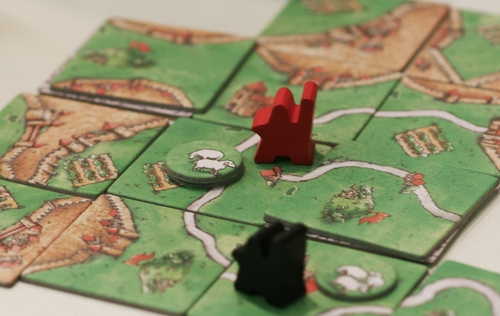
While we'll be the first to admit that some of the Carcassonne expansions have jumped the shark *coughCatapultcough*, Carcassonne: Sheep and Hills actually looks pretty good. First, there are some hill tiles, and when you place one you immediately draw another tile and place it under the hill tile, creating a...hill. Now, if there's a tie, whoever is on a hill will break the tie. This is an easy and neat little addition that's simple enough to even add to the base game when playing with newbies.

In addition, there are sheep tiles that let you draw sheep chits from a bag if you place your shepherd (a new figure) there. But beware...there are also wolf chits, and they'll gobble up your sheep.

And finally, though it's not mentioned in the title, there are also a few new tiles with vineyards on them. If you place one of these vineyards next to a monastery, then when (and only when) that monastery scores, you score three extra points.

These all seem like sensible, easy to include, not-insane expansions. I might finally dive back into Carcassonne!

Image from BGG user duchamp

The other expansion is The City at the Zwin expansion for Stefan Feld's Bruges. According to the description on the Geek, this will include:

  • Components for a 5th player.
  • Additional character cards from a new guild.
  • New stock cards that each have a special power that modifies an existing action.
  • A new mechanic where, "whenever a 3 or 4 is rolled on a die at the start of a round, a ship of the same color is placed on the supplemental game board. As an extra action, a player can discard a worker of the appropriate color, reveal the matching ship, and take the action depicted, such as advancing on the influence track or reusing a one-time power on one of your character cards."
  • Some more statues of higher values to give people incentive to build canals.
  • A revised Engraver card to replace the one from the base game, as some people thought it was overpowered.

Each of these modules can be added to the game separately, or you can add all of them for utter Bruges madness... Apparently Z-Man will be printing an English version, but no word on when it will be available.

Thanks for reading, and make sure you're subscribed, as THIS WEEK we'll be giving away a copy of Relic Expedition to one lucky follower/subscriber/liker.

Bottom Banner

Star Wars X-Wing Miniatures Wave 4 Announced

By Firestone

Oh well-played, Fantasy Flight... I finally get caught up with the first three waves of the Star Wars X-Wing Miniatures Game over Christmas, and then you go and announce Wave 4. Sneaky devils...

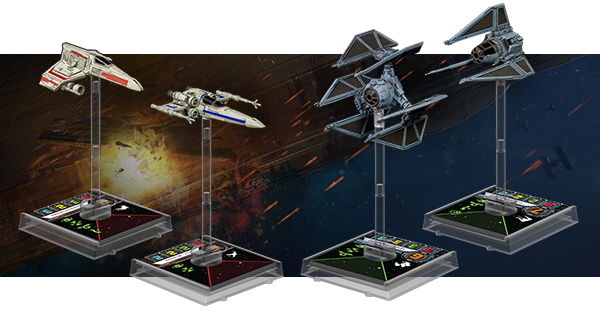
x-wingwave4


People who were wondering how much more they'd borrow from the Expanded Universe should wonder no more. All four new ships are from the EU:  the Z-95 Headhunter, TIE defender, E-wing, and TIE phantom.

From FF's Web site:

  • The Z-95 Headhunter enters the Rebel fleet as an extremely efficient missile platform, better enabling the Alliance to match Imperial forces ship-for-ship.
  • The TIE defender is a straight-forward fighter with strong shields, weapons, agility, and a maneuver never before seen on a dial.
  • The E-wing pairs the X-wing’s firepower and resilience with the A-wing’s speed and agility.
  • TIE phantom pilots rely upon the ship’s unique cloaking device to evade enemy fire and pounce upon their foes with their deadly laser cannons.

Okay, if I'm being honest, those tie fighters look like something cobbled together at a Maker Faire. Maybe that's what Stormtroopers do in their garages on the weekend. "Hey, Steve. Hand me another cold one, and let's glue nine more wings on this thing..." Don't get me wrong: I'm still buying these, of course...

For more details on each of the ships, check out the press release at Fantasy Flight. Thanks for reading, and have a great weekend!

Bottom Banner

Kickstarter Weekly--Feb. 7, 2014

Well, it's been an exciting week for us so far here at TOG, and even with the news about us being a part of the Simply Youth Ministry Conference, we've somehow found time to bring you another installment of games that are pleading their case over on Kickstarter. There's a ton of great stuff happening, so let's dig in with this week's Kickstarter Weekly!

Featured Campaign

This TownThis Town Ain't Big Enough for the 2-4 of Us! - Tasty Minstrel Games

This town may not be big, but neither is the price point for this one! For a paltry three American dollars you can get a copy of this game, plus all the stretch goals! Tasty Minstrel is owning the micro game market on Kickstarter right now, and for $3 there's no reason to wait to pull the trigger on this micro tile-placement western showdown!

The campaign ends Feb. 14, and, like we said you can get a copy for a pledge $3!! Find all the details including all the unlocked stretch goals right here!

Zep AttackZeppelin Attack - Evil Hat Productions

Mooarrrr Zeppelins! Yep, the zeppelin thing is becoming all the rage in gaming this year. This might be the first zeppelin deck-builder in gaming though. A 2-4 player card battle for air supremacy, set in the universe of  the Spirit of the Century RPG from Evil Hat Productions. As with most steam punk-ish themed games, the art will pull you in on this one!

The campaign ends on March 1. You'll have to pledge $30 for the game, and you can find all of the details, right here!

LagoonLagoon - David Chott

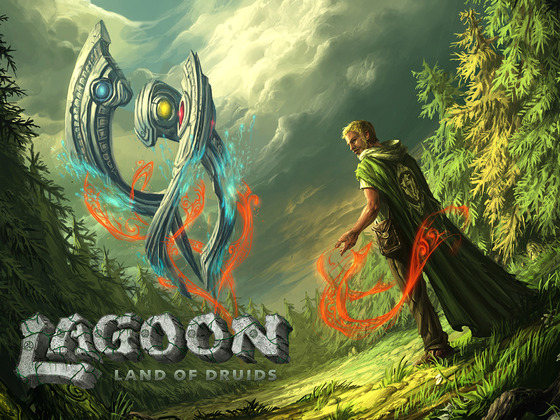
Lagoon has you embarking on a simple little objective: FORGING THE DESTINY OF A WORLD! A board game that features a solo variant and supports up to 4 players, Lagoon is a discovery and area-control game with a very mystical/enchanting feel to it. It also sports some really nice-looking components and artwork. And reviewers are claiming it has a relatively quick learning curve.

You can still pledge to get a copy of Lagoon until March 3, and it's only $35 for a copy of the game. Check out all the details right here!

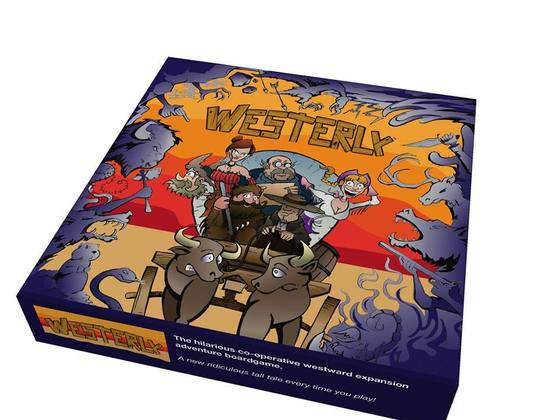
WesterlyWesterly Reboot - Analog Evolution Games

Ok, it's really just Westerly, and they've rebooted the campaign... Westerly is a co-op game where players work together to forge a trail out west using their unique characters and story-telling skills.

This game is finished and ready to roll, and more backers means more funding. They have a very lofty funding goal, but the game looks to have been very well-tested-out and tweaked, and comes with plenty of bits!

The campaign ends March 16. There are a few early bird level pledges left at $40, then it jumps up to $50 for a copy of the game. You can find out all of the details, right here!

bigfootBigfoot - Game Salute

It's time to go squatchin'... I can't believe I just typed that...

Anyway Game Salute has launched a campaign for a 2-player card game called Bigfoot, about, well, finding Bigfoot. This is an asymmetrical game in which one player is a cryptozoologist, and the other Bigfoot himself. The Bigfoot player chooses a path to take, while trying to outwit and confound the cryptozoologist. Meanwhile, his counterpart is attempting to find the ever-elusive Sasquatch and claim glory and fame. This one looks to be a very light strategy card game that plays really quickly.

The campaign ends on Feb. 27 and it's only $15 for a copy of the game. You can find all the details of the game, right here!

Thanks so much for reading! If you like what you see here on TOG, you can subscribe to our blog over on the right. And you can tell your friends about us by liking, sharing, following, and subscribing to us on Facebook, Twitter, YouTube, Instagram and iTunes!

Are you backing any of these campaigns? Are there any we missed? Let us know, down below!

Bottom Banner

Game Night at the Simply Youth Ministry Conference!

SYMC1By Firestone We know this will only apply to a fraction of our readers, but please bear with us. Jeremiah and I are excited to announce that we'll be at the Simply Youth Ministry Conference in Columbus, Ohio in early March. And we're hosting a game night!

PSMfistMy company (Group Publishing) is putting on the conference, and they've been nice enough to let us have one of the late-night options after Gungor's music set. We'll be playing The Resistance, Coup, Two Rooms and a Boom, One Night: Ultimate Werewolf, and more! So if you're going, join us! And if you're in youth ministry, and not going...WHY NOT?!

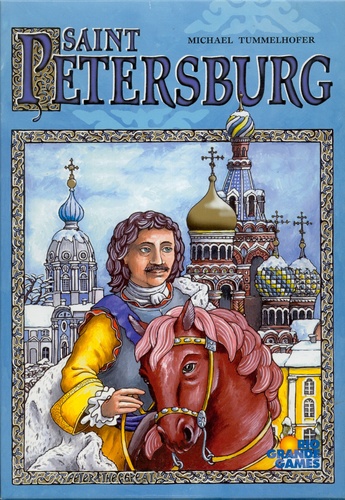
St. Petersburg is Getting a Reprint

PetersburgCoverWell...maybe. The game company Hans im Gluck has announced that, thanks to numerous requests from gamers, they'll be crowd-funding a new edition of St. Petersburg.

The company is going the crowd-funding route because they're still now sure how popular the reprint will be. If enough people show interest, it'll happen. If it fizzles, it'll stay OOP--and prices for the original will likely get a boost.

According to the announcement, the new edition will include:

  • A whole new phase (color) with private deck.
  • Options for a 5th player.
  • A graphical redesign.
  • An updated rulebook.
  • Additional modules.

It's scheduled to go live in March, on a German crowd-funding site.

Con You Help Us Out?

khaaaanWe here at TOG, love gaming cons... Well at least I (Jeremiah) do. Firestone often sulks from afar because most of the major cons happen states--if not time zones--away. Anyway, while there are some large staples in the gaming con universe: GenCon, Origins, Spiel Con, BGG Con, today we thought we'd make an open place for folks to inform others of the diamonds in the rough. It seems that unless you peruse the bulletin boards at your FLGS you won't hear much about the local cons in your area.

So here's where you come in. We'd love to hear from you, especially if you've attended a smaller local con that you think is worth checking out--just let us know down in the comments below. Let us know all the vital details: date, location, any special guests, events, and of course cost for admission. Feel free to include links or twitter accounts, and contact info as well. Remember, this is the internet and our readers are spread out everywhere, so don't hold back--the more cons listed the better!

So sound off, gaming folks: Where do you get your con on?!

Thanks for reading and contributing!

Bottom Banner